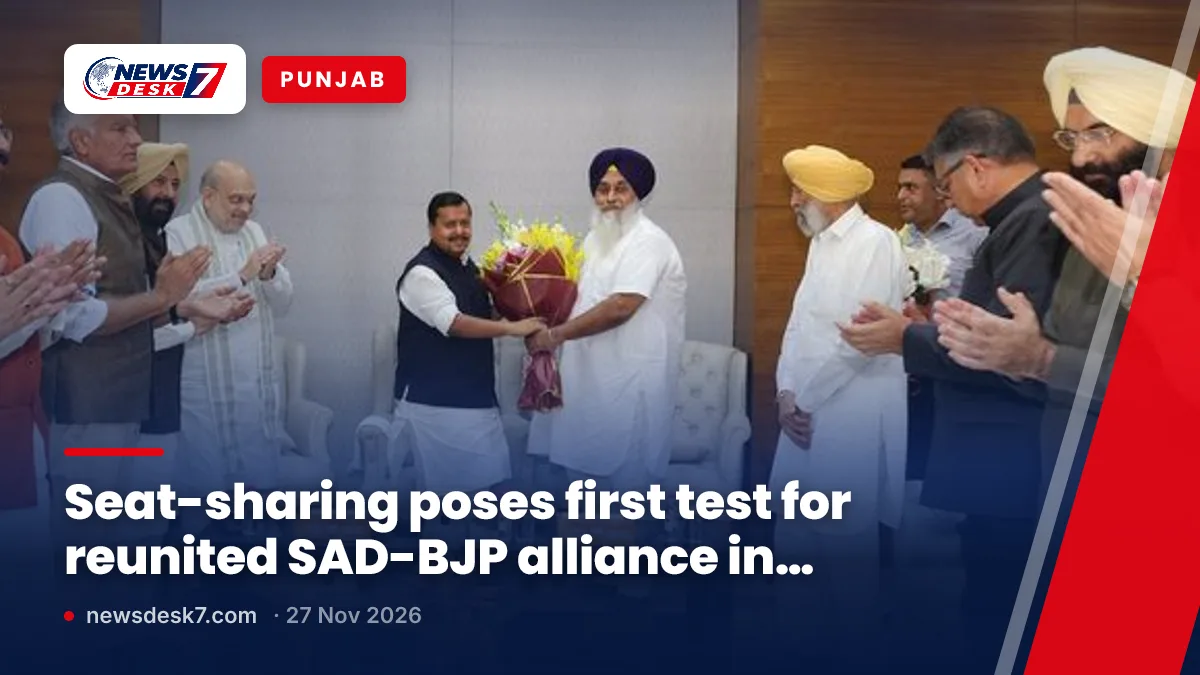
The renewed alliance between the Shiromani Akali Dal (SAD) and the Bharatiya Janata Party (BJP) might have brought back into focus the Hindu-Sikh political bonhomie in Punjab, but the narrative of reconciliation has left unresolved fault lines that led to the separation.
Beneath the bonhomie, there are not only various uncomfortable questions that neither party can afford to ignore, which includes the release of Bandi Singhs, or Sikh political prisoners.
In fact the past has caught up with the present. “The biggest challenge is likely to be seat-sharing. Despite being projected as the ‘Bada Bhai’ (senior partner), the SAD may have to make substantial concessions to its former junior partner, particularly in urban constituencies. Since the split, the BJP has invested in expanding its organisational base beyond its traditional strongholds in Doaba and Hindu dominated Majha region. It now has an eye on urban constituencies in Ludhiana, Patiala and Bathinda,” Prof PS Bhogal, psephologist and former professor of political science told The Tribune.

The BJP has also constructed a cadre in several urban Assembly segments of Ludhiana, including North, East, Central, West and South, besides Sahnewal, Patiala city and Kharar. The induction of former SAD leader and two-time Kharar contender Ranjit Singh Gill into the BJP is indicative of its attempts to bolster its position in constituencies where the Akalis once enjoyed considerable influence.
For the BJP, therefore, the alliance is not necessarily a return to the old arrangement in which it contested a limited number (23/117 seats in 2017) of seats as the junior partner. The party would anticipate a significantly larger share (more than 50), especially dominating the urban areas, and is unlikely to surrender constituencies where it has spent years building its organisation.
However, keeping the seat-sharing formula under wraps also reflects the apprehensions within both parties. An early announcement could demoralise leaders and workers who have spent years nurturing constituencies and aspiring to contest elections on their respective party tickets.
If a constituency is allotted to the alliance partner, the sidelined aspirants could either revolt, switch parties or work against the official candidate. BJP has experienced this in the recent past when former minister Tikshan Sud had censured the leadership for making “abrupt” organisational changes.
Both parties are conscious that such disgruntlement could provide an opportunity to the opposition, notably the Congress and the AAP.
The much-used criterion of ‘winnability’ is expected to become the justification for hard decisions. Leaders from both sides have reportedly conducted internal assessments to identify candidates with the best electoral prospects.
But the exercise will not be without resistance from local leaders who have invested years in building their political constituencies.
There has also been public resentment from BJP leaders against Akalis. Former Union Minister of State Ravneet Singh Bittu, who is keen on contesting from Ludhiana on a BJP ticket, has earlier been a vocal critic of the SAD leadership.
Sud had accused the Akalis of failing to act against drugs, gangster culture and sacrilege incidents, alleging that certain leaders had pursued electoral gains at the cost of religious sentiments in February this year.
Similarly, Amritsar MLA and former IPS official Kunwar Vijay Pratap Singh, who has repeatedly accused the earlier SAD administration of failing to act against those accountable for sacrilege incidents, will have to share the political platform with leaders he has targeted in the past.
For SAD, the alliance is equally consequential. From ruling Punjab for two consecutive terms between 2007 and 2017, the party has been reduced to the margins of state politics. Its tally slipped from 15 seats in 2017 to just three in 2022.
Its legislative presence has since dwindled further, with Manpreet Singh Ayali joining the Akali Dal Waris Punjab De and Dr Sukhwinder Kumar Sukhi moving to AAP. Ganieve Kaur Majithia effectively remains its lone representative in the Assembly.
The party has also suffered organisational setbacks following the emergence of SAD (Punar Surjit), led by prominent Akali leaders including Gurpartap Singh Wadala, Parminder Singh Dhindsa and Adesh Partap Singh Kairon. Multiple other leaders, including Surjit Singh Rakhra, Manpreet Singh Ayali, Charanjit Singh Brar and Iqbal Singh Jhundan, have also drifted away from the Akali fold.
The emergence of the Akali Dal Waris Punjab De has fragmented what was once a relatively consolidated Panthic political space.