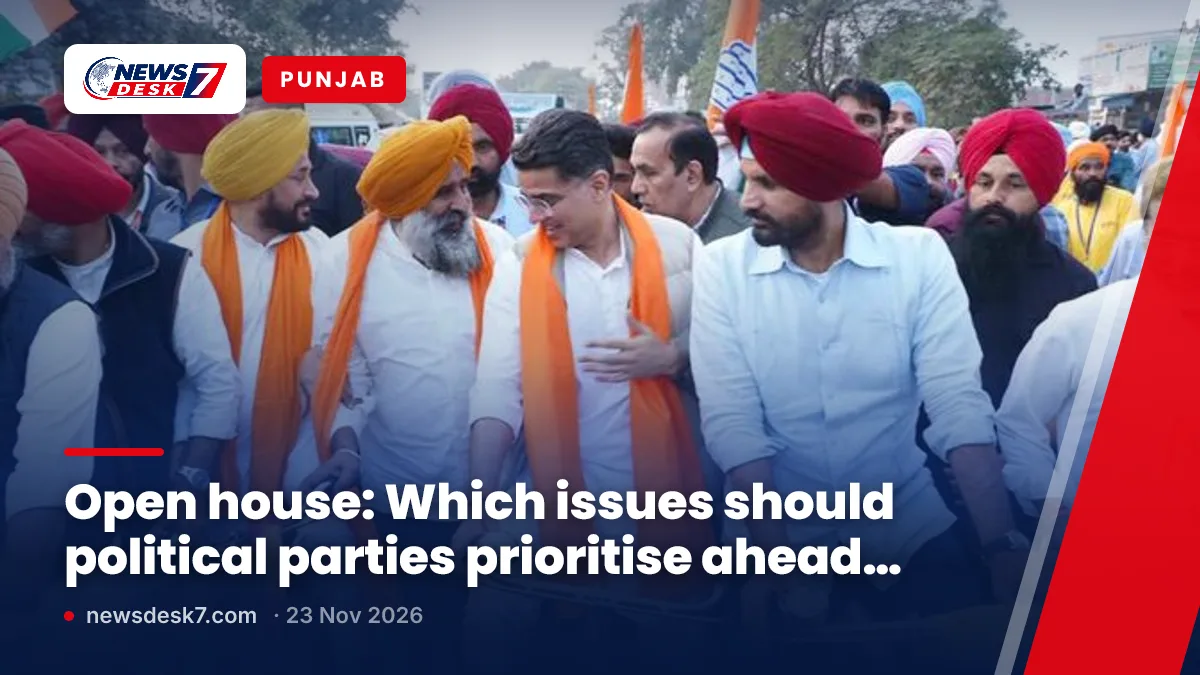
The Punjab Assembly polls in 2027 will be fought against the backdrop of the performance of the AAP government's 92-seat brute majority. The party came to power as the vox populi against the listless political scenario set up by customary parties. The flurry of promises made by the Aam Aadmi Party (AAP) generated considerable euphoria, prompting voters to bring down various old political citadels. The key poll planks revolved around anti-corruption, anti-drug, anti-illegal mining, anti-gangsterism and anti-sacrilege drives, alongside pro-farmer initiatives. Welfare steps included free electricity for the poor, MSP for growers, healthcare for all, restoration of the Old Pension Scheme, employment for youth, an education revolution and the empowerment of the common man. However, going by the visible public perception of the ruling regime in Punjab, critics argue that most of these poll promises have stayed confined to billboard displays. Even so, free electricity and the tiered cash payment scheme for eligible adult women, introduced towards the fag end of the government's term, remain the two significant projects on which AAP is looking for a fresh mandate from the people. Other political parties are highlighting the failures of AAP and promising better governance, effective law and order, control over drug mafias, employment generation, secular governance credentials and corruption-free delivery of services. More than anything else, political parties must move beyond blame games and present prioritised developmental projects aimed at supplying basic healthcare, improving education, generating employment and strengthening the industrial health of the state. For example, the sports and leather industries in Jalandhar need to be revived. Individuals, too, should raise their key worries through the media rather than fall prey to the lure of freebies. All said and done, free and fair elections depend upon an awakened and informed citizenry.
Adv Abhyam Sharma
Put public concerns first

As the Assembly elections approach, political parties are busy devising strategies to garner public support. While state-related issues are dominating the political discourse, contenders have also begun highlighting local challenges faced by citizens. However, reckless debates on sensitive issues that threaten communal harmony and social peace only divert attention from matters of wider public interest. To make sure that pressing civic issues do not remain overlooked amidst the poll din, there is an urgent need to place public concerns above petty political rivalries. Jalandhar was chosen under the Smart Cities Mission with the objective of improving the quality of life through efficient public services, robust infrastructure and a sustainable environment. Although certain zones have witnessed visible improvements through beautification initiatives, civic management continues to fall short of expectations. For example, a dumping site for domestic waste has not been finalised for years, due to which garbage disposal and irregular transportation carry on to undermine cleanliness, even in upscale neighbourhoods. Apart from this, rampant encroachments, haphazard parking on roads and in markets and dysfunctional streetlights in various localities cause frequent traffic disruptions and inconvenience to commuters. The city's infrastructure is also found crumbling even during moderate rain, exposing persistent problems of waterlogging and damaged roads. Inadequate public transport further aggravates traffic congestion, calling for comprehensive and practical solutions. Despite repeated media reports highlighting the poor state of civic facilities and sanitation, political leaders have yet to present a convincing roadmap for addressing these longstanding concerns. It is, hence, imperative for residents to draw the attention of political parties and their contenders towards pressing issues when they come seeking votes. Meaningful urban transformation requires political accountability and an informed electorate willing to put public welfare above partisan interests. Rather than being swayed by divisive rhetoric and electoral promises, electors must demand clear commitments and time-bound action on civic improvements.
Nirmaljit Singh Chatrath
Electors must demand legal accountability
A border-belted, agrarian and dera-dominated state, Punjab, which was reorganised in 1966 alongside Haryana and Himachal Pradesh, approaches the February 2027 Assembly polls at a critical juncture. Once celebrated as the food bowl of India, its industrial stagnation stems not merely from the dark phase of militancy but also from decades of policy inertia. Today, Punjab is grappling with deteriorating law and order, gangsterism, drug abuse, illegal mining, agricultural distress and mounting unemployment. Yet, instead of prioritising sectors with genuine developmental moorings, like industrialisation, education, healthcare and corruption-free governance, political parties continue to distribute reckless freebies as bait for vote bribery, pushing the state's debt towards Rs 4.48 lakh crore. Meanwhile, poll manifestos remain non-binding promises and a toothless Model Code of Conduct has could not check electoral populism. Worse, vote banks are still engineered along caste, creed and dera lines, so blatantly that convicted dera heads are repeatedly released on furlough for months on end around polls. To rescue Punjab, an awakened citizenry and civil society anticipate all stakeholders to join their heads and hearts to break this cycle. Voters must dismiss short-term doles, demand legal accountability for manifesto promises and insist on prudent resource management, fair justice mechanisms, transparency and credibility. Workable plans for education, healthcare, home security, employment generation, female empowerment and sports, together with tentative budgetary allocations, must constitute priority regions. Jalandhar, too, must emerge as a smart city.
Dr Madhuri Sharma
Regular cleaning of sewerage required
The Punjab Assembly poll notification could be issued at any time next month, in December 2026. One of the key problems faced by residents of the internal city is the need to lay new sewerage lines, as the existing ones are over 50 years old. Similarly, fresh water pipelines need to be laid because the existing pipes are also more than 50 years old. Currently, regular cleaning of sewerage lines with machines, from one main hole to another, is needed so that the slush accumulated inside the sewerage lines can be removed. Similarly, the slush from the main holes must also be cleaned regularly. Another significant difficulty is scooter and car parking. With the introduction of battery-operated three-wheelers, traffic congestion has increased manifold. Traffic signals should function properly and the working of yellow lights must be made sure. Most of the footpaths meant for pedestrians need to be cleared of encroachments, as hardly any pedestrians are able to walk on them. The width of footpaths should not exceed three feet, as anything beyond this can contribute to traffic congestion. One-way traffic regulations should be strictly implemented and the public must refrain from driving vehicles on the wrong side. The operations and maintenance wing of the Municipal Corporation should give priority to filling potholes if there is a delay in constructing roads that have developed potholes. As far as freebies are concerned, individuals are expecting the free electricity limit to be increased from 300 units to 350 or 400 units per month. The monthly pension should be uniform for all women so that every eligible woman receives an equal sum. It should also be increased to Rs 2,000 or Rs 2,500 per month. Similarly, air-conditioned buses, which were introduced by the SAD-BJP administration with only 10 per cent additional fare, are currently being used for the Tirath Yatra of pilgrims. These buses should also be considered in the context of public transport requirements. Freebies may be increased, but political leaders and parties must also keep in mind the financial burden such announcements would place on the state exchequer in these Assembly polls.
Rajat Kumar Mohindru
Improve the city’s traffic management
Though Jalandhar city is vital for Punjab's political fortunes, it has constantly been ignored by all political parties over the years. As Assembly elections approach, inhabitants of Jalandhar must raise their voices for the permanent redressal of their basic grievances and guarantee that these are prioritised by political parties in exchange for their precious votes. The most compelling grievance relates to waste management and cleanliness in general. The city is still awaiting sustainable and scientific management of its daily waste, both at the collection and disposal levels. The second most important difficulty relates to traffic management. The city is getting choked due to the ever-increasing volume of traffic and the constant failure of the traffic administration to control and manage it in a scientific and systematic manner. One wonders why traffic administrators fail to even guarantee the satisfactory functioning of traffic lights at vital crossings when the whole system is generally outsourced to private operators. Thirdly, the city needs to be freed from unauthorised encroachments and illegal activities across public places. All illegal activities that lead to the defacing of the city's landscape and hinder the smooth movement of pedestrians on roads and streets must be checked and controlled in accordance with the law and norms. Finally, the city's green cover needs not only to be protected but also enhanced substantially.
Jagdish Chander
City needs organised parking facilities
Political parties must prioritise good governance and basic civic infrastructure over slogans and electoral promises. Jalandhar urgently needs effective traffic management, better roads, organised parking facilities, improved drainage, scientific solid waste management and stringent enforcement of environmental and noise pollution laws. Public health facilities, cleanliness, drinking water, public safety and the protection of green spaces also require immediate attention. Equally vital are employment opportunities for the youth, prevention of drug abuse, support for sports, promotion of local industries and preservation of Jalandhar's cultural identity. Voters should anticipate nominees to present a clear and time-bound development agenda rather than make unrealistic promises. Transparency, accountability, accessibility and regular public consultations must become essential features of chosen representatives. Jalandhar deserves result-oriented governance, not merely election-time assurances. Development must be sustainable, inclusive and visible in the everyday lives of its citizens.
JP Singh
Create employment opportunities
Employment generation should be one of the biggest priorities for political parties ahead of the Assembly elections. Punjab has traditionally been an industrial state, yet the lack of new industries and adequate employment opportunities has forced numerous young people to move abroad in search of a better future. Despite having the potential to emerge as an industrial hub, the state has struggled to attract fresh investments and create enough jobs for its educated youth. The growing migration of young individuals is a serious concern. It is not merely about people going abroad for higher education or better lifestyles; many are leaving because they do not see a secure future or suitable career opportunities in Punjab. Successive governments have could not address this growing gap between education and employment. Political parties must move beyond poll promises and present a concrete roadmap for bringing in new industries, reviving existing industrial units, attracting investments and generating employment opportunities locally. Jalandhar, which has a strong industrial and manufacturing base, also needs focused attention to revive its industries and create employment opportunities for its individuals. Political parties must recognise the importance of local industries in generating positions and retaining the state's young talent.
Manshi Singh
Make city safer for all
The deteriorating law and order situation in Jalandhar is a key worry that political parties must address ahead of the Assembly elections. A series of firing incidents in the city, including cases linked to extortion dangers, personal rivalries and disputes, has raised serious worries about public safety. Such incidents create fear among residents and raise questions about the effectiveness of policing and the government's attempts to curb criminal activities. The recurrence of these incidents has made public safety a crucial issue that needs to be addressed by political representatives. Political parties must take law enforcement seriously to control organised crime, curb the misuse of illegal firearms and make the city safer for everyone. Making sure effective policing and preventing criminal activities must be a key part of their agenda.
Shivam Sharma
Improve education and healthcare
The development of basic civic amenities should be the top priority of every chosen representative. Politicians and leaders must contest polls on issues that directly impact the lives of ordinary residents rather than diverting attention towards irrelevant matters. The focus should remain on development, education, healthcare and the overall improvement of public infrastructure. Education and healthcare are among the most important zones requiring immediate attention. The government must ensure that schools have an adequate number of qualified educators and hospitals have sufficient medics and medical staff so that people can access quality services without difficulty. There is a shortage of educators, notably in specialised subjects like science and commerce, which affects the quality of education. Similarly, hospitals must be adequately equipped and staffed so that individuals can access proper healthcare without facing difficulties. Jalandhar, like many other cities, carries on to struggle with basic civic challenges such as damaged roads and poor sewerage systems. These issues directly impact the everyday lives of residents and demand instant attention from the authorities. Our political leaders must be held accountable for addressing these concerns. Elections should be fought on clear agendas centred on development and better public services. People deserve leaders who focus on resolving real challenges rather than indulging in unnecessary political debates.
Radhika Sharma