
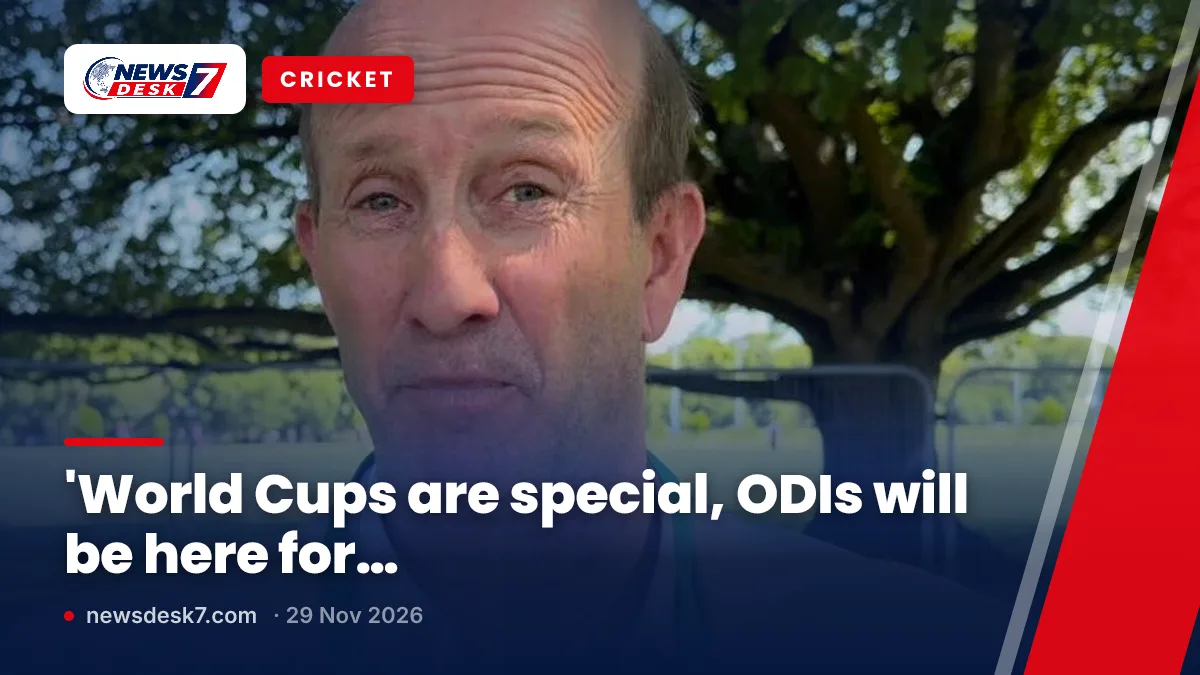
Christchurch: Chris Harris was an unsung legend for New Zealand in ODIs. Having played 250 matches for the country, he has seen and played enough cricket to become one of the most level-headed voices in the nation today. The 57-year-old former all-rounder is juggling commentary, umpiring and golf, but his "hyperactive" personality does not let him stay away from the ground for long. On the sidelines of the ongoing India-New Zealand Test, the former international spoke about the changing landscape of the game, the itch to plan dismissals and why he is open to mentoring a white-ball side.Excerpts:Modern-day cricket has changed a lot, has not it?I love watching the contemporary game, how it is changed and developed. Watching contemporary batsmen and how aggressive they are. It is quite nice, as an all-rounder, to sit back and feel sorry for the bowlers because when the modern batsman gets in, you have got to feel for the bowlers. It is so hard to stop those contemporary guys.Is it tougher now than before to be a bowler?It is not very kind to the bowlers. The bowlers do get their moments because modern batsmen are so aggressive, and that does create opportunities. But it appears that if a modern batsman gets in and gets set, it is very hard to stop him. Contemporary batsmen seem better, boundaries seem a little bit smaller, and they have got to be protected so they cannot go all the way to the edge of the stadium. So, the way modern batsmen hit the ball, there do not appear to be boundaries anywhere in the world that are large enough to stop them on their day.Why do you think there is a dearth of genuine all-rounders these days?I just think that in the contemporary game, you basically have your five batsmen and your bowlers, and you have got some bowlers who are good hitters. The contemporary game is about hitting the ball, particularly in the white-ball format. And that is perhaps why we are not seeing as many all-rounders, because you are just seeing specialists in each area. There are still some great all-rounders around, but now your openers come in and just go from ball one. It is impressive to watch. I do not know how they do it.It is such a special format. We talk about it a lot, but those World Cups are so special. The last couple of editions, I think, have been pretty special. And that is why ODIs will be here for a long time.What is your definition of a genuine all-rounder?A genuine all-rounder is someone who can get into the side as a batter on his own or as a bowler on his own. And if they can do both, the likes of maybe Ben Stokes, Andrew Flintoff, guys who are good enough to get in on their own merit in either form, then I think you always want them playing because you know how special those players are. It is likely taken away a bit more of the type of bits-and-pieces player who does a little bit of everything.Is there more pressure now than before to excel in modern-day cricket?I think most people will thrive in the modern environment because it is such a challenge and you are constantly under pressure. If you are playing a top-level sport, that is why you play the game. To be put under pressure, to be in a high-pressure situation, and to try to make the difference.I could not do it often enough, but it is really fun trying. And every once in a while, when it comes off and it works... In my era, it might be attempting to get someone like Sachin Tendulkar out or Brian Lara. And if you can change the outcome of a game through something you do, it is a pretty special feeling.Has the improved financial landscape of the game helped modern cricketers thrive?Absolutely. In any nation you were from, if you wanted to make a proper living out of cricket, you required to play international cricket in my day. Now, people do not necessarily have to play international cricket. That is why I think we are creating an era of plenty of aggressive players.Because of T20 cricket, we have seen one-day games where the run rates have gone up. Run rates are typically a lot higher now in Test cricket. Sides are going at four or five an over. And I think it is owing to that point that you do not necessarily have to play global cricket. You have just got to show that you offer something different. As a batsman, you can be super aggressive. You can score at a strike rate of 200 and make a great living just by playing T20 cricket. Domestically, whether it is the IPL or CPL, it is a different landscape now.You could have triggered a bidding conflict in the IPL for what you brought to the table...Kind of you to say, a bidding conflict. I would have just been happy to be in their thoughts. Look, to be honest, I am hyperactive. I would have loved T20 cricket. I do not think I would have necessarily excelled in any area. But, you know, I could bat, I could bowl. And fielding, I think, is a very important part of the contemporary game. I still think even now I have got possibly things to offer, different sides and ideas on fielding.And, you know, the modern T20 player, perhaps what they should be looking to do and how they should position themselves. So, yeah, I might have been able to play a role.Even the coaching landscape is changing now. We are seeing a split approach and the entry of mentors.I think the game keeps changing and developing. So, I think that is currently how it sits. But I think there will be things that come up. Psychologists have been used a little bit. Mental health, putting individuals in the right frame of mind. And that mentorship you talked about is clearly key. People have their specialist coaches outside of their usual coaches. So, I think individuals who are trying to get to the top are always looking for those little one-percenters.Little things that they can do that are going to make the difference, that are going to make them slightly better than the other guy. Because if you are playing at the top, you can guarantee that everyone at the top is trying to do absolutely everything they can to be their best. Sometimes you have got to think outside the box. And who knows what comes next? There will be something that comes up and works for someone. And then they go, "Oh, this is working for me because of this." And others will try it. So, I think you have always got to keep pushing the boundaries and keep looking to find ways to get better.There are plenty of questions around the relevance of ODIs. What is your take?We get asked this question every year or every couple of years. And everyone says one-day cricket is struggling. You have got T20s now, that is the modern one-day game. And you have still got conventional Test matches. They are the two formats. And then a World Cup comes around.It is just such a special time. We see some of the greatest white-ball games, great finishes, semi-finals especially, and finals. And when the World Cup comes around, it is such a special format. To answer your question, we talk about it a lot, but those World Cups are so special. The last couple of editions, I think, have been pretty special. And that is why ODIs will be here for a long time.Get the newest Sports News and Live updates. Download the TOI app.
'World Cups are special, ODIs will be here for a long time': Chris Harris
Christchurch: Chris Harris was an unsung legend for New Zealand in ODIs. On the sidelines of the ongoing India-New Zealand Test, the former international spoke about the changing landscape of the game, the itch to plan dismissals and why he is open to mentoring a white-ball side.Excerpts:Modern-day…
EEditor
29 नव॰ 2026, 06:14 am 7 मिनट में पढ़ें
यह ख़बर सुनें
E