

In the razor-thin environment, the VCK’s 2 seats have acquired disproportionate significance




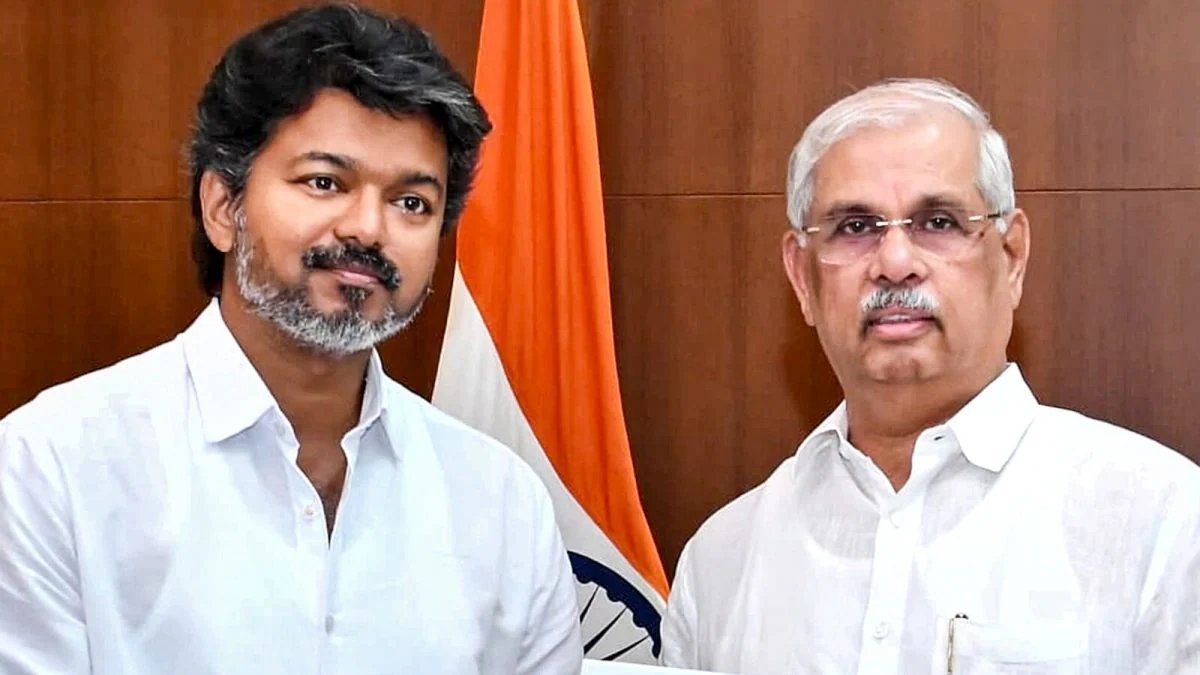
Tamil Nadu Governor Rajendra Arlekar with Tamilaga Vettri Kazhagam (TVK) chief Vijay during a meeting, at Lok Bhavan, in Chennai. File image/PTI
The political landscape in Tamil Nadu has shifted into a high-stakes numbers game as actor-politician Vijay and his Tamilaga Vettri Kazhagam (TVK) move within striking distance of the “magic number” of 118. Following a dramatic fallout within the INDIA bloc, the Congress and the Left parties have signalled their intent to back the debutant, leaving the Viduthalai Chiruthaigal Katchi (VCK) as the final, decisive piece of the legislative puzzle.
Maths of the Mandate
With the TVK emerging as the single largest party with 108 seats, Vijay initially faced a ten-seat deficit. However, the ground shifted on Thursday when the Congress (5 seats) and the Left parties (CPI and CPI(M), 2 seats each) broke ranks with the DMK. This “secular realignment” has brought Vijay’s tally to 117—just one seat shy of a formal majority, though some calculations including the IUML place him exactly at the threshold.
In this razor-thin environment, the VCK’s 2 seats have acquired disproportionate significance. If Thol. Thirumavalavan moves his legislators into the TVK camp, Vijay will comfortably cross the 118 mark, ending the week-long deadlock at Lok Bhavan and forcing Governor Rajendra Arlekar’s hand.
Will the VCK Cross the Rubicon?
The VCK finds itself in a profound ideological dilemma. For over a decade, the party has been a cornerstone of the DMK-led Secular Progressive Alliance. However, the scent of power-sharing—a long-standing demand of Thirumavalavan for his community—is a powerful lure. Reports suggest that Vijay personally reached out to the VCK chief on Thursday night, reportedly offering a significant role in the new administrative setup.
The VCK’s hesitation stems from its core “anti-Sanatana” platform. While the Congress justified its switch as a move to keep “communal forces” (the BJP) out of a hung assembly, the VCK is wary of how its base will perceive an alliance with a brand-new party whose ideological depth is still being tested.
The Governor’s Deadlock
Governor Rajendra Arlekar has already twice declined Vijay’s invitation to form the government, insisting on a physical “list of 118″ signatures rather than oral assurances. The VCK’s decision is the only thing standing between a TVK-led cabinet and a potential recommendation for President’s Rule.
As the VCK high command meets today, the question is no longer just about stability but about the survival of the old guard. If the VCK joins the TVK, it marks the definitive end of the “Dravidian Duopoly”—not just at the ballot box but in the corridors of power.
Read More