


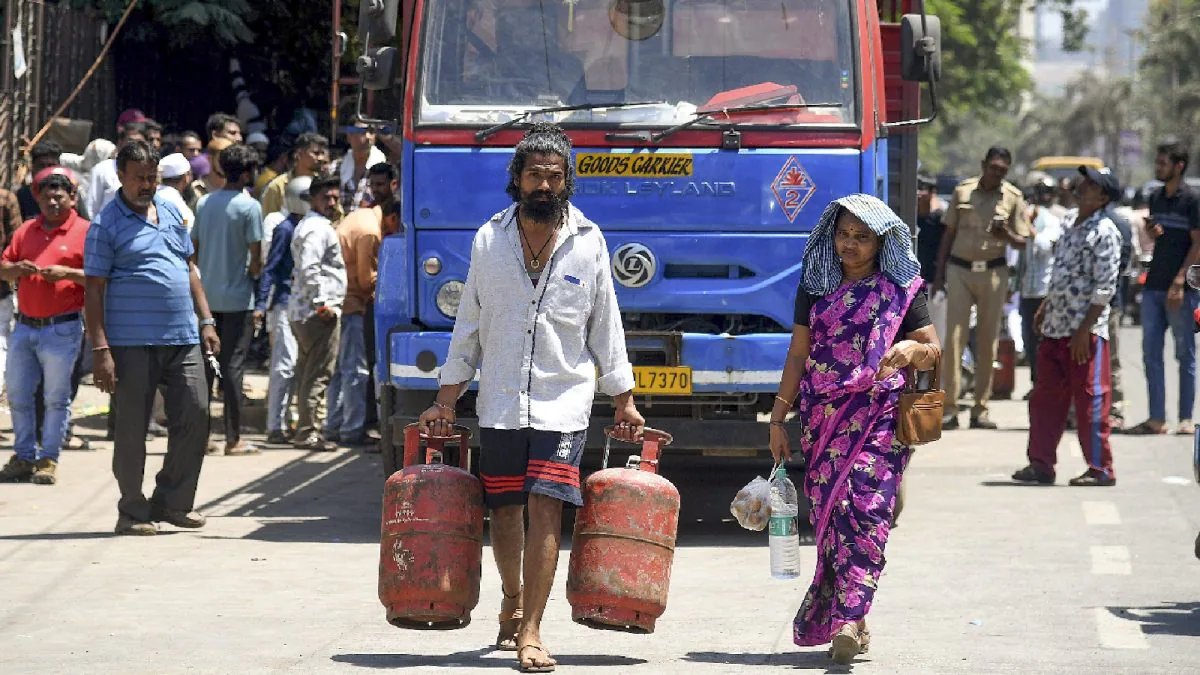
Higher LPG prices are already impacting commercial users such as hotels, restaurants and small businesses, while also increasing subsidy pressures on oil marketing companies.




A man carries empty LPG cylinders on a sunny afternoon, amid disruptions in LPG supplies due to the ongoing West Asia war, at Malad, in Mumbai, Maharashtra. (IMAGE: PTI)
A senior government official told Moneycontrol that restoration of global liquefied petroleum gas (LPG) supply chains could take three to four years, while pointing to rising import risks for India.
A senior government official said the restoration of global LPG supply chains could take three to four years, as it remains unclear whether production has been halted temporarily or if there has been permanent damage.
Speaking to Moneycontrol, the official also flagged increased import risks for India, noting that the country relies heavily on West Asia for its LPG supplies.
LPG supplies to India and the wider world have been disrupted due to the effective closure of the Strait of Hormuz since February 28, when US-Israeli strikes on Iran escalated the ongoing conflict. Iran has since retaliated by attacking military bases housing US troops and energy sites across West Asia.
Drone and missile attacks have been carried out on gas processing facilities and export terminals by both sides. In West Asia, LPG is primarily produced at gas processing facilities linked to major fields such as the South Pars gas field and North Field, and to a lesser extent at oil refineries. The fuel is then exported through terminals in Qatar, Saudi Arabia and the UAE via the Strait of Hormuz.
“Based on inputs from affected suppliers, restoration could take at least three years, and possibly longer,” the official was quoted as saying by Moneycontrol.
The report also highlighted that India’s LPG import dependence remains high, with about 60 percent of its consumption met through imports.
Before February 28, nearly 90 percent of these supplies were routed via the Strait of Hormuz. As of March 24, the share of imports from West Asia declined to 55 percent.
“Your LPG supply might take that long because some of the very critical LPG supplies are shut down. What ‘shut’ exactly means is not fully clear — whether entire wells have been exhausted or production has stopped — but they themselves are saying it will take at least three years,” the official further added.
LPG production in West Asia is anchored in large gas fields and processing hubs. Iran’s South Pars gas field, the world’s largest, is a major source of propane and butane, while Qatar’s North Field, part of the same geological basin, feeds LPG output through extensive processing infrastructure.
Facilities such as Ras Laffan Industrial City in Qatar and the Habshan Gas Processing Plant in the UAE play a central role in separating LPG components from raw natural gas.
At these plants, propane and butane are extracted before the remaining gas is converted into LNG, making them critical to global LPG supply.
Even after production, LPG must be transported to international markets through key export terminals.
Major hubs include Ras Laffan Port in Qatar, Yanbu Port in Saudi Arabia and the Fujairah Oil Terminal in the UAE.
These facilities handle storage and loading of LPG shipments, connecting regional supply to global demand.
Most of this trade moves through the Strait of Hormuz, a vital shipping route, and current disruptions are significantly impacting LPG availability and prices globally.
The UAE, Saudi Arabia, Qatar, Kuwait, Bahrain and Oman together supplied 92 percent of India’s LPG, with imports valued at $6 billion in FY25.
The UAE, which accounted for 41 percent of India’s LPG imports, has been among the worst affected by Iran’s drone and missile attacks, while Qatar, which accounts for 22 percent, remains a key but vulnerable supplier.
Domestic LPG cylinder prices have risen by Rs 60 since mid-March, while commercial cylinder prices have increased by Rs 115 over the same period.
April 15, 2026, 16:20 IST
Read More