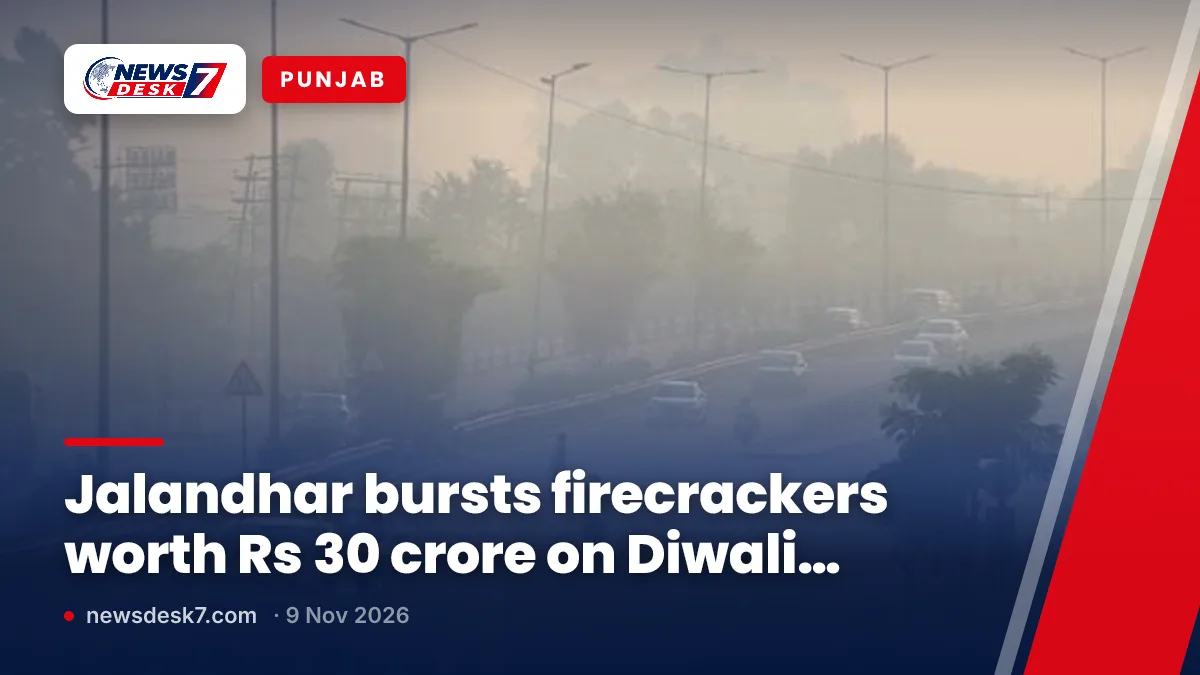
Firecrackers worth over Rs 30 crore were burst in Jalandhar during Diwali festivities, with residents continuing the festivities well past midnight and into the early hours. The prolonged bursting of crackers led to a sharp deterioration in air quality, with the city's Air Quality Index (AQI) crossing the 300 mark a day after Diwali.
Despite the Supreme Court's restrictions limiting firecracker bursting to the 8 pm to 10 pm window, crackers continued to be burst across the city late into the night.
Traders said firecracker sales and bursting went on beyond Diwali day, with individuals also celebrating Vishwakarma Puja, noted by industrialists, traders and businessmen across the city after Diwali.

Jalandhar stayed among the most polluted cities in Punjab, with PM2.5 emerging as the major pollutant. The city's AQI stood at 239 at 4 pm on Diwali day but climbed to 328 by noon on Monday, a day after the celebration.
A thick haze hung over the city during Diwali, while inhabitants complained of coughing and eye irritation. The pollution had already been affecting Jalandhar for more than a week before the festival.
Firecracker traders report decent business
Despite concerns over pollution and restrictions on the sale of firecrackers, wholesalers and retailers reported decent business this Diwali, although they said the limited number of authorised stalls and sale days impacted their earnings.
A farmland in Raowali village was designated as the firecracker sale site in Jalandhar this year. Approximately 20 wholesalers and retailers set up shops at the location.
Vikas Bhandari, president of the Jalandhar Fireworks Association, said sales stayed decent, but authorised traders accounted for only around half of the total firecracker sales in the city.
"Of all the firecrackers sold in Jalandhar, our establishments at Raowali managed only about half. We could set up just 20 stalls at Raowali and that too for only four days. However, more than 800 stalls illegally sold firecrackers across Jalandhar without any permission," he stated.
Bhandari added that authorised traders had to spend between Rs 75,000 and Rs 1.5 lakh each on permissions, electricity, rent, transportation and legal expenses.
"After incurring all these expenses, we were given only a limited number of days to sell crackers. Business remained decent but would have been much better if we had more days. We selected the site and informed the government. The administration should consider providing more locations for firecracker sales, on the lines of Ludhiana," he stated.
He also flagged the condition of the Raowali site, saying there was considerable dust at the location. The traders had even compensated the landowner to guarantee the crop was harvested on time, he remarked, adding that the administration could at least have arranged a water tanker to settle the dust.
Firecracker trader Raghav Mahajan stated business was good, with customers turning up in reasonable numbers, but four days were insufficient for sales.
He also remarked individuals should not blame or single out Hindu festivals for deteriorating air quality, arguing that several factors contribute to pollution.
Another trader, Baldev Raj, stated the arrangements were smoother when firecracker stalls were previously set up at Burlton Park.
"People have to go out of their way to reach the Raowali site. These issues must be addressed," he noted.