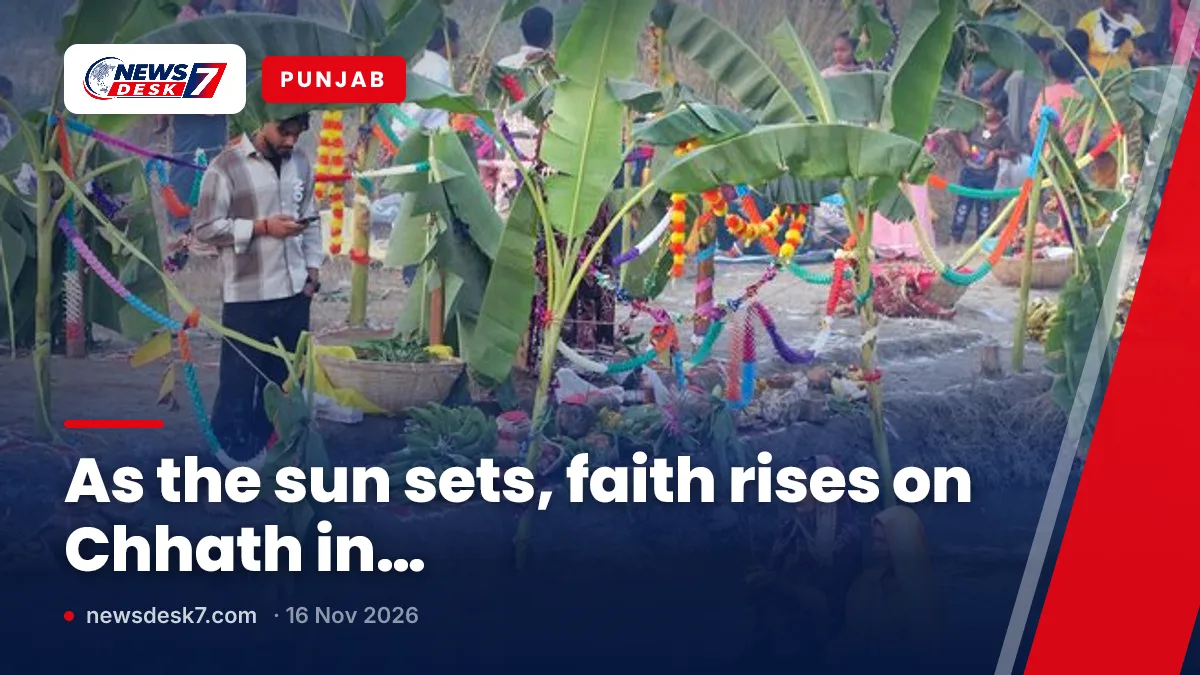
Chhath Puja was celebrated with religious fervour and enthusiasm in Phagwara on Sunday evening, with over 45,000 devotees, mostly migrants from Bihar and Uttar Pradesh, gathering along the Chachoki distributary to offer arghya (sacred offering) to the setting sun. The Sutlej at Phillaur also witnessed a massive gathering, with lakhs of devotees participating in the conventional rituals.
A significant feature of this year’s festivities at Chachoki was the availability of water in the distributary, which had remained dry for several years. Water was specially released into the canal for the occasion, offering relief to devotees who would otherwise have faced difficulties performing the rituals. The neglected distributary had shrubs, accumulated waste and litter along its bed and banks. In Phagwara, water was also supplied to the canal through a tubewell installed nearby in 2014.
A festive atmosphere prevailed along the Chachoki canal, situated on the outskirts of Phagwara, as devotees assembled with offerings and customary puja materials. Many migrant families illuminated their homes, burst crackers and organised community meals (langars). Young volunteers also helped regulate traffic along the busy GT Road to facilitate the movement of devotees and prevent congestion.

Political leaders cutting across party lines also took part in the celebrations. Member of Parliament Dr Raj Kumar Chabbewal, Phagwara Mayor Ram Paul Uppal, former minister Som Parkash, philanthropist Anita Som Parkash, Vijay Sampla and Phagwara MLA Balwinder Singh Dhaliwal visited the venues and interacted with devotees. They also addressed the gatherings from separate stages.
It was learnt that political representatives had approached the Irrigation Department for the release of water into the distributary to facilitate the festivities. Chhath Puja holds immense religious and cultural significance for individuals from Bihar and eastern Uttar Pradesh, who constitute a sizeable migrant population in the region. However, the festival is increasingly attracting participation from the local Punjabi community as well.
Several Punjabi families were also seen participating in the rituals. While some may have been drawn by political and social considerations, others appeared motivated by religious curiosity and cultural affinity. Some local locals contributed vegetables, including radishes, while others presented boxes of apples for devotees. Punjabi women were also among those observing the conventional fast, reflecting the festival’s growing acceptance beyond its traditional communities.
The district administration and police stayed on alert to make sure the smooth conduct of the festivities. Additional Deputy Commissioner Randeep Singh Heer, SDM Phagwara Navjot Sharma, Superintendent of Police Major Singh, Traffic In-charge Aman Kumar Daveshwar and SDO (Water Supply) Pardeep Chottani monitored the arrangements and the situation at the venue until late evening.
Chhath Puja is one of the most notable festivals for individuals from Bihar, Jharkhand, eastern Uttar Pradesh and adjoining regions. Dedicated to the Sun God and Chhathi Maiya, the celebration entails rigorous religious observances, including fasting, prayers and offerings to the setting and rising sun. Devotees traditionally observe a demanding fast, frequently abstaining from both food and water during the prescribed period.
Following Sunday evening’s arghya to the setting sun, devotees were slated to perform the customary Kosi ritual at their houses, accompanied by prayers and the singing of Chhath hymns. The festivities will conclude on Monday morning, when devotees will offer arghya to the rising sun before breaking their fast.
Vijay Kumar, Ravi Kumar and Anil Kumar, three siblings participating in the festivities, said the festival was traditionally known as Ravi Khashti Vrata, a fast dedicated to the Sun God and noted on the sixth day after Diwali.
The large turnout at Chachoki and Phillaur underlined the deep cultural and religious attachment of migrant communities to Chhath Puja. The participation of local locals, meanwhile, reflected the festival’s growing presence in Punjab’s diverse social and cultural landscape.