

Vijay made one thing very clear on Day One: this government does not want to look like the past




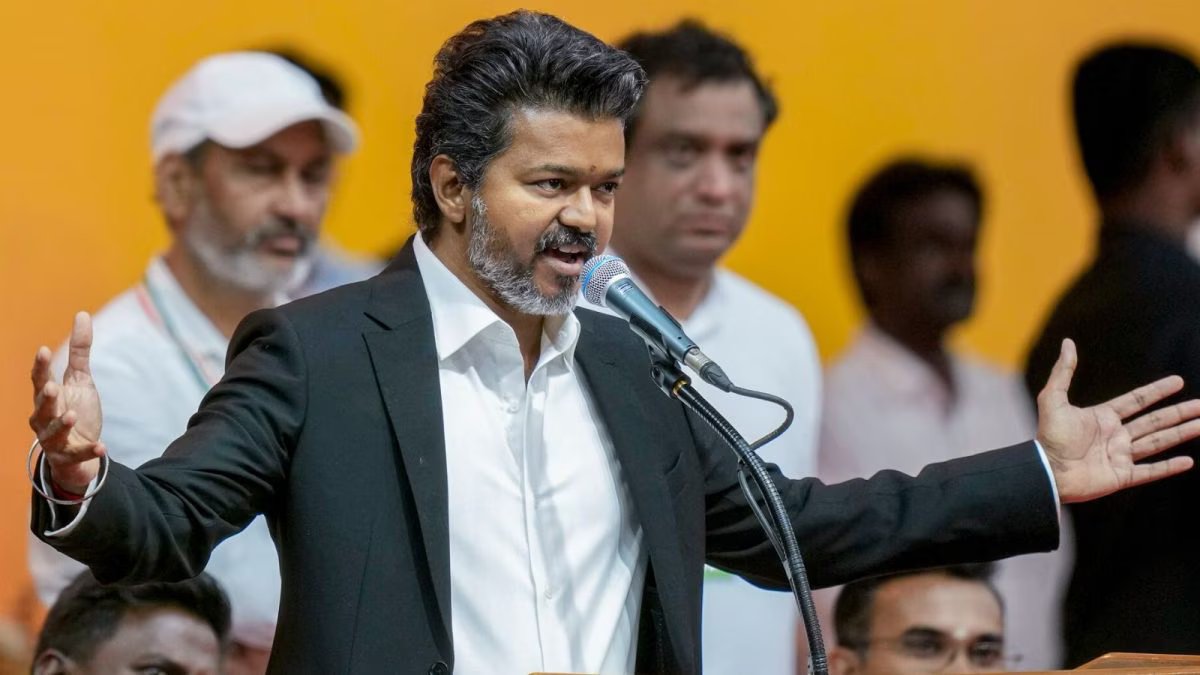
Vijay during his oath-taking ceremony in Chennai on Sunday. (PTI)
For decades, Tamil Nadu’s chief ministers arrived in power wearing the familiar ‘political uniform’ of the state — white veshti, white shirt, and the unmistakable symbolism of Dravidian politics.
But on Sunday morning at Chennai’s Jawaharlal Nehru Indoor Stadium, C. Joseph Vijay chose a very different image. Black trousers. Crisp white shirt tucked in neatly. A blazer. No veshti. No attempt to resemble the DMK or the AIADMK.
Even before he spoke, Vijay was sending out a message: this was not meant to look like politics as Tamil Nadu had always known it. It felt less like a traditional swearing-in ceremony and more like the launch of a new political era — polished, media-conscious and designed for a younger generation that consumes politics through television clips, Instagram reels and viral moments.
The symbolism did not end with the outfit. Traditionally, Tamil Nadu leaders complete the oath-taking ceremony and quietly exit after the constitutional formalities. Vijay did the opposite. He stayed back and addressed the gathering directly. Then came another carefully choreographed moment — he signed official government files on stage, in full public view, cameras zooming in from every angle.
It was governance being packaged as spectacle. A visual statement aimed at television audiences and social media timelines where optics often travel faster than policy.
And Vijay’s message was blunt. “There are no parallel power centres in TVK. I am the only head,” he declared. It was a line clearly aimed at shutting down speculation about shadow advisors, hidden camps or unelected influencers within the party. Tamil Nadu politics has long been shaped by factional battles, succession struggles and inner circles. Vijay seemed determined to establish authority from the very first hour.
But the speech was not only about power. There was also emotion — something Vijay understands perhaps better than any contemporary politician in the state. He repeatedly spoke about inclusivity, stressing that the government would belong equally to Hindus, Muslims and Christians. Then came the line that drew some of the loudest applause inside the stadium: “Whether you are my friends or my enemies, all 8 crore people are my people.”
It was classic Vijay — cinematic, emotional and universal enough to resonate across political divides.
At several points, he also positioned himself as someone who had suffered before reaching this stage. He spoke about humiliation, criticism and obstacles during his political journey. “I faced insults, many problems… despite everything, people stood with me,” he said. It was an attempt to transform attacks into political legitimacy — a formula many successful regional leaders in India have used before.
At the same time, Vijay also appeared conscious of the enormous expectations surrounding him. He asked the public for patience, admitting that governance takes time to stabilise. But even while asking for breathing room, he moved quickly to project action.
On stage itself, he signed orders announcing 200 units of free electricity, a special anti-drug task force and another dedicated women’s protection force. The sequence was deliberate: emotion first, executive action next.
Women’s safety and drug control clearly emerged as central themes of the new government. Both issues resonate strongly with urban middle-class families, young voters and parents. The anti-drug campaign especially has been one of TVK’s strongest political messages over the last year, framed almost as a moral fight for Tamil Nadu’s future.
Vijay is also expected to directly oversee policing, intelligence and internal security — a sign that the new Chief Minister wants tight control during the uncertain early months of his administration.
And surrounding him is an unusually mixed political ecosystem — loyalists, technocrats, digital strategists, professionals and veterans from rival parties.
TEAM VIJAY A MIX OF YOUTH, EXPERIENCE
At the centre of that circle stands N. Anand, better known as Bussy Anand — arguably Vijay’s closest political confidant. Long before TVK became a full-fledged political party, Anand was helping convert Vijay’s fan clubs into booth-level organisational networks. A former MLA from Puducherry’s Bussy constituency, he became the bridge between fandom and political machinery. Emotional visuals of him breaking down during the TVK flag launch only strengthened his image as Vijay’s fiercely loyal lieutenant.
His rise also reveals something important about Vijay’s style of politics: loyalty matters more than ideological pedigree.
Then comes Aadhav Arjuna, perhaps one of the most intriguing figures in the broader TVK ecosystem. Over six feet tall and a former national-level basketball player, he carries a very different political personality from the traditional Tamil Nadu strongman. Educated in political science, experienced in campaign consulting and connected across multiple political circles, Arjuna represents the growing professionalisation of Indian politics.
He has moved through several political ecosystems — DMK, VCK and now TVK — carrying with him expertise in strategy, narrative-building and campaign management. He is also believed to have played a role years ago in introducing political consultant Prashant Kishor to the DMK setup before relations later soured.
Another face drawing attention is Keerthana, the 29-year-old first-time minister who defeated senior DMK leader Rajendra Balaji. Fluent in eight languages and coming from a political consulting background, she became one of TVK’s most recognisable young campaigners. She also faced heavy trolling online for speaking fluent Hindi — a sensitive issue in Tamil Nadu politics — but instead of retreating, she leaned into the criticism and emerged even more visible politically.
Her rise signals something larger: TVK is consciously rewarding communication skills, youth and technocratic competence instead of relying only on seniority.
Then there is P. Venkataramanan from Mylapore, whose induction carries historical significance. His appointment is being discussed because a Brahmin leader has entered the Tamil Nadu cabinet after nearly seven decades. A chartered accountant and advocate, he represents the urban professional face of TVK and suggests the party has managed to attract sections of upper-middle-class voters frustrated with the old Dravidian binaries.
On the other side of the spectrum stands KA Sengottaiyan — the veteran presence inside an otherwise youthful ecosystem. A nine-time MLA and former AIADMK heavyweight, Sengottaiyan brings decades of administrative and political experience. Even after switching parties, he retained his personal hold over Gobichettipalayam, showing that his support base goes beyond party symbols.
For Vijay, Sengottaiyan offers something invaluable: institutional memory and grassroots understanding.
The policy brain of the party, meanwhile, is widely seen to be KG Arun Raj — doctor, former IRS officer and one of the architects of TVK’s manifesto. Fluent in English television debates and comfortable with policy language, Arun Raj became one of the party’s most visible intellectual faces. Ironically, attacks from rivals only increased his public profile.
And then comes the digital machinery — a major reason behind TVK’s explosive rise among younger voters.
Rajmohan, the former YouTuber behind “Tamil Vanakkam,” helped shape TVK’s online communication style through humour, memes and simplified political language. Alongside him operated C. T. R. Nirmal Kumar, who many believe built the party’s aggressive online ecosystem. Having earlier worked in BJP and AIADMK digital networks, he understood algorithm-driven politics better than most traditional politicians.
Together, they helped TVK dominate social media through decentralised meme pages, WhatsApp chains and rapid-response online narratives.
But the celebrations and visuals of Day One may soon collide with the hard realities of governance.
Because Tamil Nadu has seen actor-politicians before. And every successful cinematic rise eventually faces the same question: can charisma become administration?
VIJAY’S CHALLENGES: CROWN OF THORNS?
The biggest challenge ahead for Vijay is political stability. TVK may be the single largest force, but it still depends on allies like Congress, Left parties and the VCK. Tamil Nadu historically prefers dominant single-party structures, not fragile coalition management. Every cabinet decision, every legislative negotiation and every seat-sharing discussion could become a source of friction.
Then comes governance itself. Running a state is very different from running a campaign. Bureaucracy, fiscal management, crisis response and administrative discipline require a different temperament altogether. Many analysts believe voters backed “Vijay the symbol” more than TVK the organisation.
That becomes especially important because TVK still lacks the deep institutional machinery that parties like the DMK and AIADMK built over decades. Much of the party structure is young, inexperienced and still evolving. Vijay now has to build a functioning governance ecosystem while also ensuring rival camps do not emerge internally.
And waiting outside is a powerful opposition.
M. K. Stalin and the DMK may have lost power, but their networks remain deeply entrenched across Tamil Nadu’s political and administrative landscape. Every mistake by the new government will be amplified aggressively.
The AIADMK, despite its weakened state, still retains influence in several rural pockets and caste belts. Rumours of factional manoeuvring and political poaching are already circulating.
The economic situation may prove even tougher. Tamil Nadu already carries massive welfare commitments and fiscal pressures. At the same time, young voters expect jobs, rapid development and visible change. But governance moves far slower than cinema narratives.
And perhaps Vijay’s most difficult challenge will be managing expectations from his own supporters.
His fanbase expects transformation at cinematic speed — corruption disappearing overnight, instant justice and dramatic administrative change. But real governments move slowly. If the gap between cinematic imagination and bureaucratic reality becomes too large, disappointment could arrive quickly.
Then there is the Centre-State relationship. Vijay campaigned aggressively against the BJP on issues like NEET, language politics and federal rights. That means tensions with New Delhi could become inevitable. Even the friction during government formation hinted that Raj Bhavan may become an important battleground in the months ahead.
Law and order is another early test. Political transitions in Tamil Nadu have historically triggered clashes, defections and aggressive cadre mobilisation. For a first-time administration led by relatively inexperienced political managers, maintaining stability will be critical.
And finally comes the larger ideological question: what exactly does TVK stand for beyond anti-establishment energy?
Opposition politics and governance politics are not the same thing. Eventually, Vijay will have to define a clear economic, social and political direction for the state. Without that clarity, sustaining momentum becomes difficult.
Taken together, Vijay’s first day as Chief Minister revealed something bigger than a normal change in government. This is not purely cinema politics. Nor is it traditional Dravidian mobilisation. It is a hybrid experiment — fan-club energy mixed with digital warfare, corporate-style branding mixed with emotional populism, young professionals standing alongside old political veterans.
Even the black trousers and blazer mattered.
Because in Tamil Nadu, symbolism has always mattered.
And through his clothing, his speech, his public signing ceremony and the team standing around him, Vijay made one thing very clear on Day One: this government does not want to look like the past.
Read More