

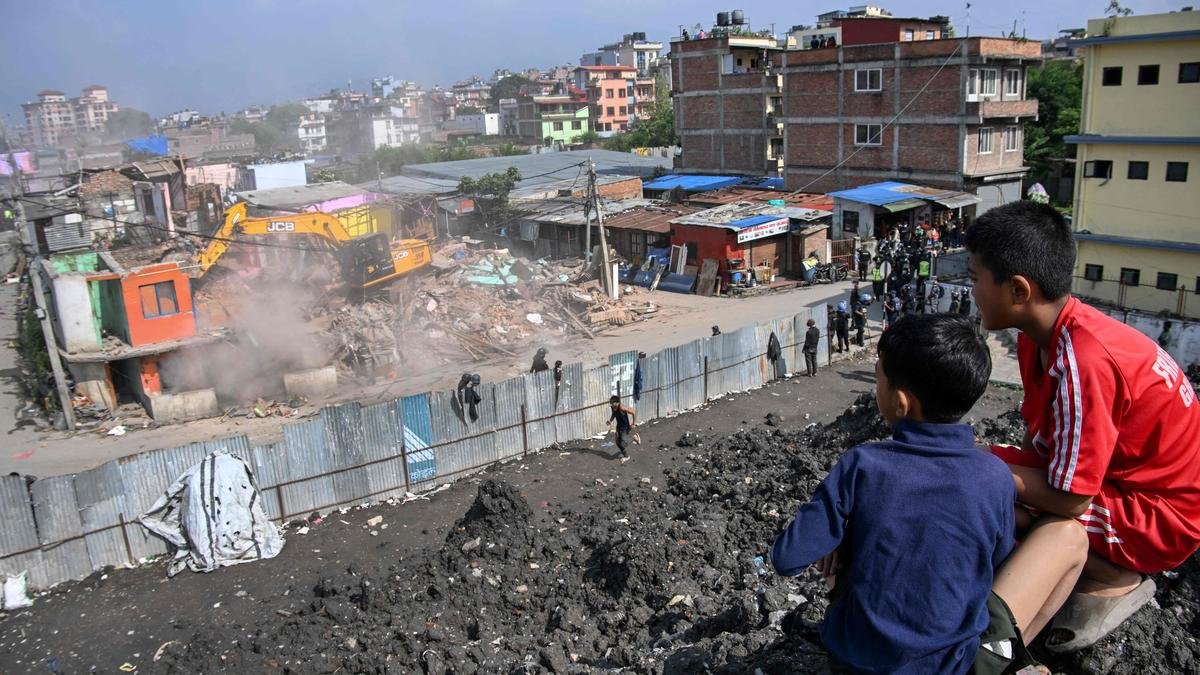
Mr. Shah’s Rastriya Swatantra Party (RSP) won a whopping 182 seats — just two shy of a two-thirds majority — in the March elections, triggered by last September’s Gen Z protests. Analysts and observers say the Shah government is trying to rule by ordinances, bypassing legislative debate, even as it moved to evict landless squatters, with security forces razing houses and other structures along the riverbanks in the Kathmandu Valley.
Mr. Shah, 35, was sworn in as Prime Minister on March 27, 2026, days after the RSP’s unprecedented victory. Despite a comfortable majority in Parliament, the government pushed through ordinance after ordinance instead of immediately convening a parliamentary session.
Nepal’s Constitution requires the government to recommend ordinances to the President, who, as the constitutional head of state, must issue them.
The ordinance push coincided with mounting pushback over the government’s clearance of “illegal” settlements, leaving many without homes and children without schools, as some school buildings were also demolished.
Demolition drive
On April 23, 2026, Mr. Shah instructed security agencies to remove “illegal” settlements along Kathmandu’s riverbanks. Criticism came as swiftly as the action.
Analysts say the concern is more about the process than the intent.
“The action bordered on cruelty. The squatters’ issue, which has been pending for years, needed to be addressed, but it could have been handled in a more managed manner,” said Dambar Khatiwada, political commentator and writer. “Such hasty moves were bound to face reproach.”
Responses, however, were mixed, rooted in both humanitarian concerns and political prejudice.
“Political parties that were routed in the last elections harbour some dislike for the RSP, so Mr. Shah’s moves met with fierce Opposition,” said Mr. Khatiwada. “From a general perspective, voices raised against what was akin to a demolition drive were justified.”
Over 3,000 familes now homeless
Within days, more than 3,000 families, rendered homeless, had registered for shelter at temporary holding centres.
The RSP won on an anti-incumbency platform, campaigning against Nepal’s three main parties — the Nepali Congress, CPN-UML, and CPN (Maoist Centre) — accusing them of perpetuating corruption and patronage politics. While the merit of these allegations may be debatable, analysts note that previous governments failed to address the squatter issue. Government lands, especially along riverbanks, were increasingly encroached upon — not just by the landless, but also by those connected to traditional parties.
While a similar drive to clear illegal settlements in 2013 did not spark street protests, civil society members criticised this government’s actions as inhumane. As many as 28 prominent civil society members said in a statement on May 4, 2026 they “are alarmed that the government is repeatedly moving toward violations of the Constitution and restrictions on civil liberties.”
In response to these concerns, Mr. Shah, who has not made a public appearance since taking office, turned to his preferred communication channel — social media.
“The government’s attention has been drawn to various public comments and interpretations regarding the management processes it has initiated, in accordance with the law, in areas along the rivers of the Kathmandu Valley and government-owned land where unauthorised encroachments have been identified,” he wrote on social media platform X on May 4, 2026. “The information received indicates attempts to create fear and raise doubts among landless and informally settled citizens, suggesting that they might be evicted due to these processes,” he said.
He added that “certain provisions of the Land Act 2021, which had been obstacles to the implementation of long-term solutions, have been repealed through an ordinance, considering the current situation.”
Executive moves
The ordinance mentioned by Mr. Shah is one of eight that the government recommended in the past few days. While ordinances are constitutionally permitted, the Opposition focused on two points: the RSP’s comfortable majority, and the government’s decision to call and then immediately withdraw a parliamentary session before sending ordinances to the President.
Some ordinances were issued swiftly by President Ramchandra Paudel, while one related to the Constitutional Council was initially held and sent back for reconsideration. The government insisted, and the President ultimately issued the ordinance, paving the way for appointments in 18 constitutional bodies.
Civil society members said that attempts to govern through ordinances, bypassing Parliament, indicate that the government is moving toward authoritarianism.
“Postponing a parliamentary session it had called to bring in ordinances constitutes a disregard for constitutionalism and the parliamentary system,” they said.
“By choosing the path of ordinances instead of presenting Bills in Parliament and making laws through sufficient debate and discussion, the party that won nearly a two-thirds majority undermines both the mandate it received and the practice of parliamentary procedure,” the added.
The Constitutional Council ordinance nearly triggered a full-blown tussle between the executive and the President, a ceremonial institution envisioned by Nepal’s Constitution. Even Mr. Poudel faced criticism for sending it back, as the Constitution does not explicitly allow the high office to do so. The conflict was averted once the ordinance was issued, and the Shah government then on Tuesday (May 5, 2026) called a parliamentary session for May 11, 2026.
Analysts note that the RSP came to power promising change, and it is under pressure to deliver.
“This is too early to pass strong judgment on this government. Some of its moves may look hasty, but overall the intent seems to be right,” said Lokraj Baral, a professor of political science at Tribhuvan University. “As far as criticism over dismantling structures along the riversides is concerned, it goes without saying that it could have been done differently.”
Published – May 08, 2026 01:15 am IST