

Senior military commanders said Operation Sindoor was planned to be “lethal” and “precise”, with carefully selected targets and minimal collateral damage.




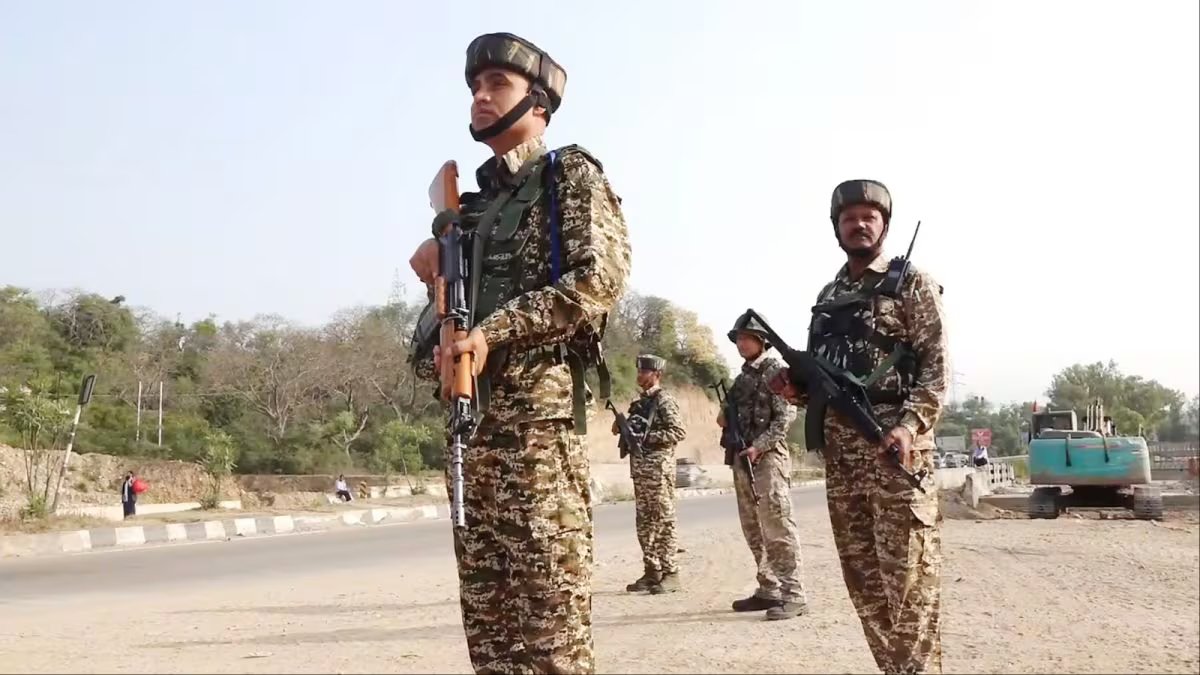
Jammu: Security personnel stand guard along National Highway-44 (Photo: PTI)
Air Marshal Bharti on Thursday said that India’s aim during Operation Sindoor was not just to hit, but it had to be lethal and precise.
The remarks came during a joint press conference addressed by top officials of the Army, Air Force and Navy, who underlined that the operation was designed to deliver a decisive response while maintaining escalation control and minimising civilian harm.
“Our aim was not just to hit. It had to be lethal. It had to be precise, avoiding collateral damage in the selection of targets, timing weapons to be used, everything needed to be carefully considered,” Air Marshal Bharti said, describing the planning and execution behind Operation Sindoor as senior military commanders detailed India’s calibrated military response following the Pahalgam terror attack.
Speaking about the operational planning, Air Marshal Bharti said the top commanders met “almost daily” before the strikes and carefully worked through the selection of targets, weapons and timelines.
“Execution was achieved with clockwork precision,” he said, adding that the operation was aimed at terrorist infrastructure and support systems, while ensuring “no collateral damage”.
The Air Marshal also defended the decision to halt hostilities after the operation.
“We had achieved our objectives and our mission was complete,” he said, adding that the Indian response became “lethal and ruthless” once Pakistan chose to intervene directly after the initial counter-terror action.
“After taking the beating, sense kicked in in the adversary, and they asked for cessation of hostilities. We paused when the request came. We stepped back, but we didn’t blink,” he said.
‘OPERATION SINDOOR WAS A JOINT EFFORT’
Also speaking at the event, Lt Gen Rajiv Ghai said Operation Sindoor reflected India’s “whole of government approach”, with multiple arms of the state working together in coordination.
Paying homage to civilians killed in the Pahalgam attack, he said the operation went “beyond the years, while approaches and methods and target terror across the Line of Control with precision and clarity”.
According to Lt Gen Ghai, the government had provided two clear directives, “clear political military objectives” and “operational flexibility”.
He said the operation integrated land, air and maritime capabilities through “shared situational awareness, common operation, intelligence pictures and real-time decision making”.
He further revealed that seven targets were struck by the Indian Army and two by the Indian Air Force.
“The targets were timed to perfection, achieved total surprise and inflicted maximum damage in each established terror hubs deep in Pakistan-occupied Jammu and Kashmir and Heartland Pakistan, signalling that no sanctuary is safe,” he said.
Lt Gen Ghai said Pakistan’s attempts to strike Indian military infrastructure failed because of a carefully prepared air defence architecture.
He added that the operation highlighted India’s growing indigenous defence capabilities, noting that systems such as BrahMos, Akash, advanced surveillance platforms and homegrown ammunition played a “decisive role”.
“Operation Sindoor proved that aatmanirbharta is not just a slogan, it is indeed a force multiplier,” he said, adding that over 65 per cent of India’s defence equipment was now manufactured domestically.
‘OUR DESIRE FOR PEACE WAS MISTAKEN FOR WEAKNESS’
Air Marshal Bharti said India’s restraint after repeated terror incidents had been misread.
“Our desire for peace was mistaken for weakness, and our silence was taken as absence,” he said.
“In such a situation, there is no choice but to act, and when we act, there are no half measures. It is decisive, it is legal.”
He described the moment the first strike was launched in the early hours of May 7, 2025, saying it represented “the strength and the resolve of the people of India being projected into the enemy heartland”.
Calling it “partial justice” for the victims of the Pahalgam attack and previous terror incidents, he said the operation reaffirmed the primacy of air power and validated the importance of jointness and net-centric warfare.
The Air Marshal also said the Indian Air Force had now gained first-hand knowledge of Pakistan’s capabilities and tactics.
“We are also able to see through our adversary. We now have first-hand confirmation of the capabilities, capacities and tactics they intended to hide,” he said.
NAVY SAYS PAKISTAN FORCED INTO DEFENSIVE POSTURE
Vice Admiral AN Pramod said the Indian Navy rapidly shifted into combat readiness after the Pahalgam attack and deployed its carrier battle group, submarines, aircraft and special forces in the northern Arabian Sea.
Naval personnel also participated in the precision strikes carried out on the night of May 6-7 alongside the Army and Air Force, he said.
He stated that forward deployment by the Navy forced Pakistani naval and air assets into a defensive posture and contributed significantly to escalation control.
“India effectively called the bluff on Pakistan’s nuclear blackmail,” he said while speaking about the use of long-range precision weapons against terror hubs.
The Vice Admiral also highlighted the increasing relevance of drones, autonomous systems and counter-unmanned aerial systems in modern warfare and said India was accelerating their integration into military operations.
PM MODI, UNION MINISTERS MARK ANNIVERSARY OF OPERATION SINDOOR
The press conference came as Prime Minister Narendra Modi and several Union ministers marked the first anniversary of Operation Sindoor by changing their social media display pictures to the operation’s logo.
Defence Minister Rajnath Singh, External Affairs Minister S Jaishankar and Home Minister Amit Shah were among the leaders who updated their profile pictures following the Prime Minister’s appeal.
PM Modi described the operation as a moment when the armed forces “showcased their valour and gave a firm response to those who attacked our people”.
Rajnath Singh called Operation Sindoor a “powerful symbol” of India’s resolve and preparedness, saying it reflected “unmatched precision, seamless jointness and deep synergy across services”.
Amit Shah described it as an “epochal mission” that would remind enemies of the striking capability of India’s armed forces.
The nearly 88-hour military conflict between India and Pakistan following the launch of Operation Sindoor ended after both sides reached an understanding on May 10.
Read More