


Decoding delimitation numbers: South worried delimitation may put them at disadvantage, but govt sources explain how it could lead to rise in number of Lok Sabha seats for region




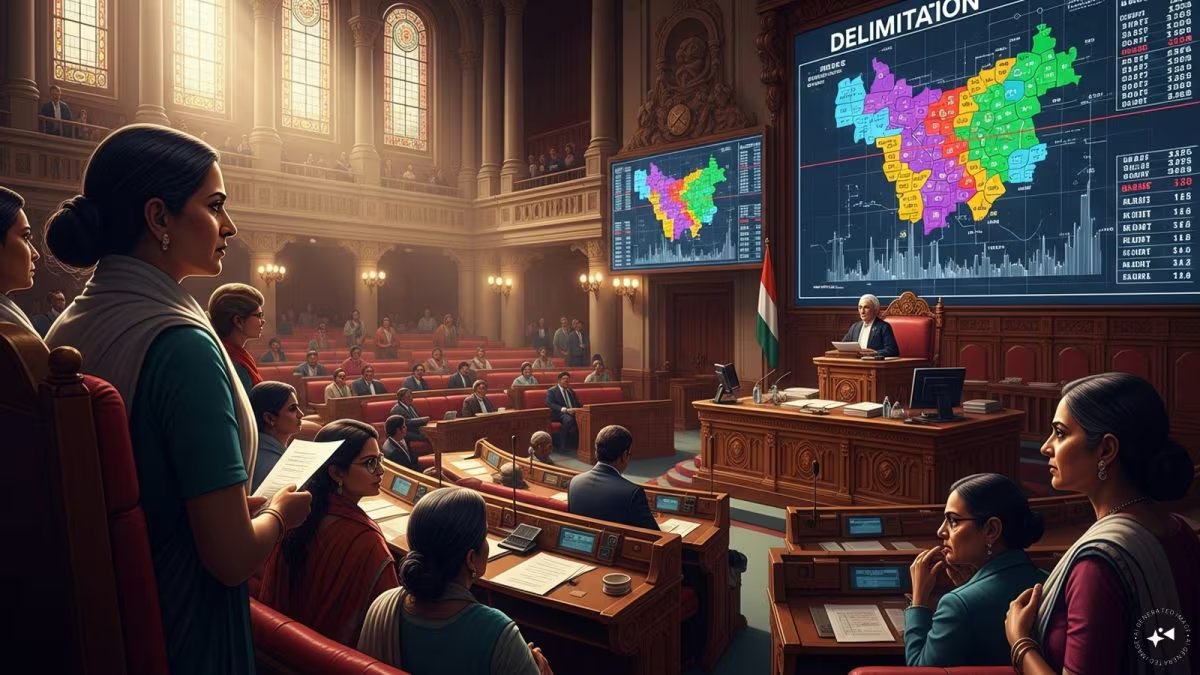
The government plans to introduce a Delimitation Bill, 2026, to redraw constituency boundaries based on 2011 Census data instead of waiting for new population figures. (AI generated for representation)
While southern states raise concerns over delimitation, which the Centre has proposed for implementation of the women’s reservation bill, government sources told News18 that the plan to increase the share of all states in Lok Sabha uniformly by 50% will actually benefit the region.
Union Minister Kiren Rijiju wrote on X: “Some people are trying to mislead the South Indian States on Women Reservation by providing wrong Delimitation figures. There should be no politics in giving reservations to Women in Lok Sabha and Legislative Assemblies. All political parties are united for Nari Shakti.”
A breakdown of the numbers.
Delimitation and women’s reservation: What the Centre plans to do?
The Nari Shakti Vandan Adhiniyam (officially the Constitution [106th Amendment] Act, 2023), originally passed in 2023, reserves one-third of all seats for women in the Lok Sabha, State Legislative Assemblies, and the Delhi Legislative Assembly.
As it requires a fresh Census and delimitation exercise before taking effect, the law enacted in 2023 can only come into effect after the next Census (delayed to 2027), potentially pushing the rollout to 2034.
The solution
To push for its implementation, the government proposes to delink the reservation from the requirement of a fresh Census and subsequent delimitation.
A central part of the plan is to increase the total number of Lok Sabha seats from 543 to up to 850, with 815 seats proposed to the states and the remaining 35 for the Union Territories. Of these, 273 seats would be reserved for women. This expansion allows for the women’s quota without reducing the number of existing seats for current members.
The government plans to introduce a Delimitation Bill, 2026, to redraw constituency boundaries based on 2011 Census data instead of waiting for new population figures.
The government intends to move a Constitution amendment bill for implementation of a 33 per cent reservation for women in the Lok Sabha from 2029 in a special sitting of Parliament on April 16-18.
What the govt needs
For the constitutional amendments, the government will require a two-thirds majority in both Houses to pass the legislation.
Why Southern States are against it? How they perceive delimitation
Southern states have historically invested more in education, healthcare, and family planning, leading to lower population growth compared to the North. Because delimitation is population-based, northern states like Uttar Pradesh and Bihar could gain a massive number of seats—projections suggest UP could go from 80 to over 140 seats.
Southern states, despite their developmental success, would see their relative share in Parliament shrink. For example, Kerala might see 0% seat growth, while Tamil Nadu’s seat share could be significantly diluted.
A significant increase in seats for northern states could lead to a permanent shift in national power toward the “Hindi heartland”.
Southern leaders fear they will have less say in choosing the Prime Minister or passing national legislation if a few northern states can form a majority on their own. There are concerns that national policies will be tailored to northern priorities, potentially ignoring the unique industrial and social needs of the south.
Tax devolution (the sharing of central taxes with states) already uses population as a key factor. Southern states contribute a disproportionately large share to India’s GDP and tax revenue. They fear that having fewer MPs will weaken their ability to bargain for a fair share of central funds, essentially leading to a situation where they “pay more but get less”.
Critics argue that a purely arithmetical approach to delimitation undermines the “spirit of federalism”.
Leaders like Tamil Nadu CM MK Stalin and Telangana CM Revanth Reddy argue that seats should be allocated based on broader factors like economic contribution, good governance, and education, rather than just raw population numbers.
Delimitation may actually lead to rise in seats: What govt sources say
“The 2011 population will not be the binding factor. That means proportionately nothing changes. This will assuage the concern of southern states that their representation might drop,” said sources.
“There will be no disadvantage to southern states. The same proportion that exists today will be maintained. The headline number will rise by 50 per cent to 850 and that number for each state will also rise by 50 per cent,” they clarified.
How the 50% formula would work: Govt sources’ explanation
- Tamil Nadu: It currently has 39 seats. If delimitation was done solely on the basis of the 2011 Census, it would have had 49 seats. But as per the GOI’s formula of increasing the shares of all states proportionately and by 50%, it will now have 59 seats.
- Kerala: It currently has 20 seats. If delimitation was done solely on the basis of the 2011 Census, it would have had 23 seats. But as per the GOI’s formula of increasing the shares of all states proportionately and by 50%, it will now have 30 seats.
- Andhra Pradesh: It currently has 25 seats. If delimitation was done solely on the basis of the 2011 Census, it would have had 33 seats. But as per the GOI’s formula of increasing the shares of all states proportionately and by 50%, it will now have 37 seats.
- Odisha: It currently has 21 seats. If delimitation was done solely on the basis of the 2011 Census, it would have had 28 seats. But as per the GOI’s formula of increasing the shares of all states proportionately and by 50%, it will now have 31 seats.
- Telangana: It currently has 17 seats. If delimitation was done solely on the basis of the 2011 Census, it would have had 24 seats. But as per the GOI’s formula of increasing the shares of all states proportionately and by 50%, it will now have 25 seats.
- Karnataka: It currently has 28 seats. If delimitation was done solely on the basis of the 2011 Census, it would have had 41 seats. But as per the GOI’s formula of increasing the shares of all states proportionately and by 50%, it will now have 42 seats.
INDIA bloc to oppose the bill
INDIA bloc leaders on Wednesday decided to oppose the delimitation bill pushed with an amendment to Nari Shakti Vandan Adhiniyam, 2023, to provide 33 per cent reservation for women legislators in Lok Sabha and state assemblies.
The opposition clarified that it is not against the women’s reservation and urged them to implement Nari Shakti Vandan Adhiniyam, 2023 but objected to the delimitation process, which they believe weakens the representation of the southern and north-eastern states in the Lok Sabha.
The decision was made in a meeting at the residence of Congress President Mallikarjun Kharge in Delhi. Along with Congress President, Lok Sabha Leader of Opposition Rahul Gandhi, RJD Working President Tejashwi Yadav, NCP (SP) MP Supriya Sule, Shiv Sena (UBT) MP Sanjay Raut, Rajya Sabha MP Kapil Sibal, and other prominent INDIA bloc leaders attended the meeting.
After the meeting, Mallikarjun Kharge announced the INDIA bloc’s decision, accusing the government of making a “politically motivated” move to suppress the opposition parties.
“We are all in favour of the Women’s Reservation Bill. But the way in which they have brought it, we have reservations about that. It is politically motivated. Just to suppress the Opposition parties, the government is doing this. Though we have supported the Women’s Reservation Bill continuously, we insist that the earlier amendments be implemented. They are playing some tricks with delimitation. We all parties should unitedly should fight in Parliament. We will oppose this bill, but we are not against the reservation (for women),” Kharge said.
KEY FAQs
Will ‘50% delimitation formula’ keep redistribution fair?
It refers to a proposal where only 50% of parliamentary seats are redistributed based on updated population, while the remaining 50% stay as they are. This is meant to balance fairness (population-based seats) with stability for states that controlled population growth.
Why are southern states worried about delimitation?
States like Tamil Nadu, Kerala, and Karnataka have successfully reduced population growth. A full population-based redistribution could reduce their share of seats compared to northern states with higher population growth.
How could the 50% formula give the South more seats?
Because only half the seats would depend on population, southern states would retain a large portion of their existing representation. At the same time, they could still gain some seats from overall expansion—meaning they avoid major losses and may even see a net increase in representation.
With agency inputs
April 15, 2026, 18:41 IST
Read More