




















UGC Bill 2026 has emerged as one of the most debated higher education reforms in recent years, drawing sharp reactions from students, teachers, administrators and policymakers across India. Introduced by the University Grants Commission to strengthen protections against caste-based discrimination and ensure equity on campuses, the UGC Bill 2026 replaces the earlier 2012 framework with a far more structured and stringent regulatory system. While supporters describe it as a long-overdue corrective measure to address systemic inequality, critics warn that its broad provisions could lead to misuse, over-regulation and unintended consequences for academic freedom.
UGC Bill 2026 has been framed against the backdrop of a steady rise in reported discrimination cases in universities and colleges between 2019 and 2024. Several high-profile incidents and student protests pushed the issue of social justice in higher education to the forefront of national discourse. The new law aims to move beyond symbolic commitments by imposing legally enforceable obligations on institutions and their leadership. In doing so, it seeks to transform equity from a policy aspiration into an operational mandate.
The University Grants Commission, established in 1956 under the Ministry of Education, has historically been responsible for maintaining academic standards, regulating universities and ensuring quality education across India. With UGC Bill 2026, the regulator has taken on a more interventionist role, shifting focus from funding and coordination toward compliance, accountability and rights protection. This marks a significant evolution in the UGC’s institutional philosophy and authority.
At the heart of UGC Bill 2026 are the Promotion of Equity Regulations 2026, which replace the earlier 2012 anti-discrimination rules. These new regulations provide clearer definitions of discriminatory conduct, introduce strict timelines for grievance redressal and place direct responsibility on institutional heads. The law mandates the creation of Equal Opportunity Centres and equity committees in every higher education institution, ensuring that complaints are not handled informally or ignored. The emphasis is on creating a visible, accessible and time-bound grievance ecosystem for students from marginalised backgrounds.
One of the most widely welcomed aspects of UGC Bill 2026 is its expansion of protective coverage. Along with Scheduled Castes and Scheduled Tribes, the bill explicitly includes Other Backward Classes, persons with disabilities and women within its equity framework. This broader inclusion reflects changing social realities and acknowledges that discrimination in academic spaces is multidimensional. For many students, especially first-generation learners, the bill signals institutional recognition of lived experiences that were earlier minimised or dismissed.
Another major strength of UGC Bill 2026 lies in its focus on accountability. Unlike previous guidelines, which often lacked enforcement mechanisms, the new law fixes responsibility squarely on the head of the institution. Vice-chancellors, principals and directors can no longer claim ignorance or procedural delays when complaints arise. This shift is intended to dismantle a culture of institutional denial and compel leadership to treat discrimination complaints with urgency and seriousness.
The time-bound grievance process is also considered a significant improvement. By requiring acknowledgment of complaints within 24 hours and completion of inquiry within a fixed period, UGC Bill 2026 addresses one of the most persistent complaints from students: delays that stretch for months or even years. Faster resolution not only reduces psychological distress but also prevents academic and career setbacks for complainants.
From a policy perspective, UGC Bill 2026 promotes uniformity across India’s vast and diverse higher education landscape. Earlier, institutions interpreted anti-discrimination norms differently, leading to inconsistent outcomes. The new law attempts to standardise procedures, reporting structures and monitoring mechanisms, thereby reducing regional and institutional disparities in handling equity issues.
Despite these strengths, UGC Bill 2026 has also triggered intense controversy. Critics argue that while the intent is commendable, the language of certain provisions remains overly broad. Terms related to discriminatory behaviour are seen by some as insufficiently precise, raising fears that normal academic disagreements or administrative decisions could be misconstrued as discrimination. This perceived ambiguity has become a central point of opposition.
Another concern frequently raised is the potential misuse of complaint mechanisms. Opponents of UGC Bill 2026 fear that the system could be weaponised to settle personal scores or exert pressure on faculty members. In highly competitive academic environments, even unproven allegations can damage reputations and careers. Critics argue that the bill does not adequately balance complainant protection with safeguards for the accused.
Institutional autonomy has also emerged as a key issue in the debate around UGC Bill 2026. Universities argue that excessive regulatory oversight may undermine their ability to manage internal affairs independently. Mandatory structures, external monitoring and the threat of punitive action are viewed by some administrators as encroachments on academic self-governance. This tension between regulation and autonomy lies at the core of the controversy.
Faculty groups have expressed anxiety about the chilling effect the bill could have on teaching and evaluation. They fear that strict accountability provisions might encourage overly cautious behaviour, discouraging open discussion, critical feedback and rigorous assessment. According to critics, academic freedom could be compromised if educators constantly worry about complaints arising from routine academic decisions.
Social and political reactions to UGC Bill 2026 further reflect India’s deeply layered caste discourse. Supporters see the law as a moral and constitutional necessity to correct historical injustice, while detractors perceive it as reinforcing divisions rather than fostering unity. The surge in online searches and protests related to “UGC Bill 2026 controversy” highlights how emotionally charged the issue has become.
The enforcement framework under UGC Bill 2026 introduces national-level monitoring committees with representation from multiple stakeholders. While this is intended to ensure compliance and transparency, critics question whether such bodies will have the capacity to handle the volume and complexity of cases across thousands of institutions. Concerns about bureaucratic overload and inconsistent enforcement remain unresolved.
From an analytical standpoint, UGC Bill 2026 represents a bold but risky intervention. Its benefits lie in formalising equity, empowering marginalised students and forcing institutions to confront uncomfortable realities. Its risks stem from ambiguity, potential misuse and the challenge of implementing uniform standards in a highly diverse education system. The success of the law will ultimately depend on how sensitively and transparently it is enforced.
UGC Bill 2026 also raises a larger question about the future direction of higher education governance in India. It signals a move toward rights-based regulation, where student welfare and social justice take precedence over institutional discretion. Whether this shift will lead to genuinely safer and fairer campuses or generate new conflicts remains to be seen.
As debates continue and legal scrutiny intensifies, UGC Bill 2026 stands at a critical crossroads. It embodies both the promise of reform and the perils of overreach. For students seeking dignity and fairness, it offers hope. For institutions navigating compliance and autonomy, it presents a complex challenge. The coming years will determine whether UGC Bill 2026 becomes a landmark in educational justice or a cautionary tale in regulatory design.
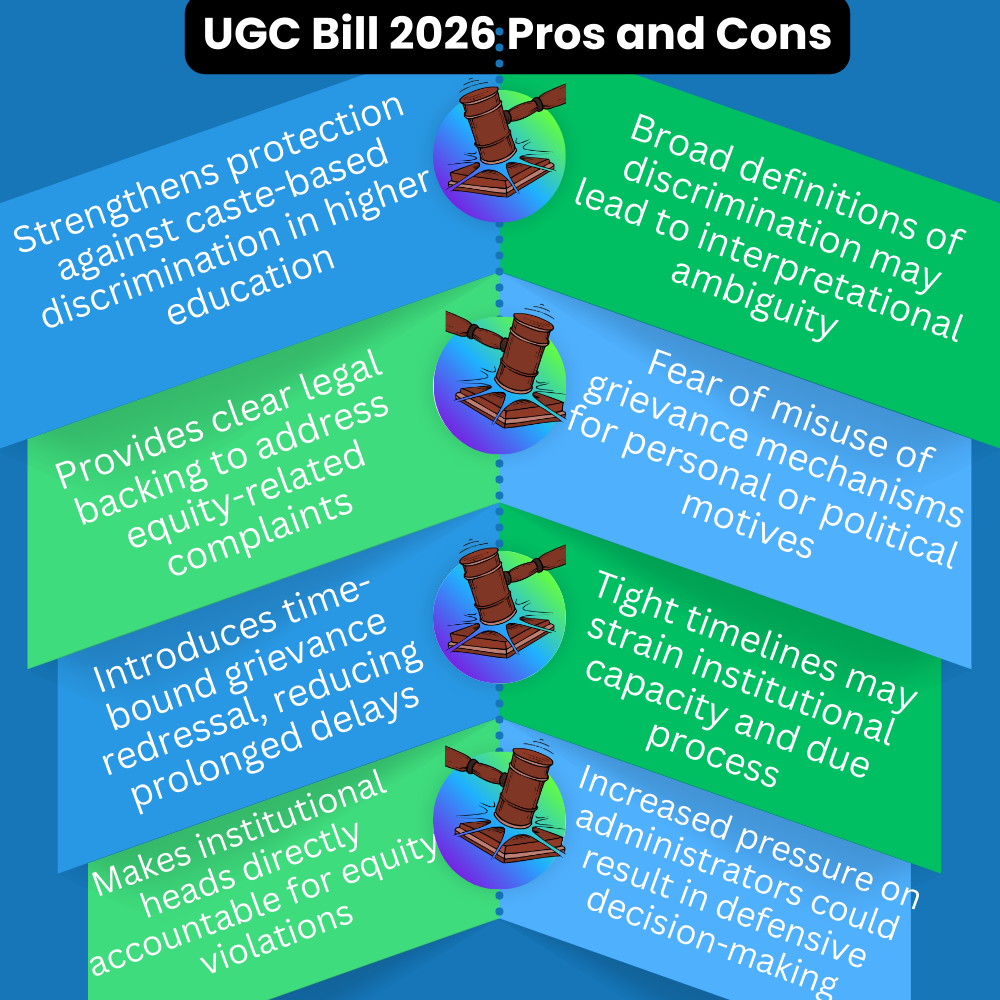
UGC Bill 2026: Pros and Cons
| Pros of UGC Bill 2026 | Cons of UGC Bill 2026 |
|---|---|
| Strengthens protection against caste-based discrimination in higher education | Broad definitions of discrimination may lead to interpretational ambiguity |
| Provides clear legal backing to address equity-related complaints | Fear of misuse of grievance mechanisms for personal or political motives |
| Introduces time-bound grievance redressal, reducing prolonged delays | Tight timelines may strain institutional capacity and due process |
| Makes institutional heads directly accountable for equity violations | Increased pressure on administrators could result in defensive decision-making |
| Mandates Equal Opportunity Centres in all institutions | Smaller colleges may face resource and staffing challenges |
| Expands protection to OBCs, PwBDs and women alongside SC/ST groups | Critics argue inclusion framework lacks clarity on overlapping categories |
| Establishes national-level monitoring and oversight mechanisms | Concerns over excessive centralisation and regulatory overreach |
| Promotes uniform implementation of equity norms across India | Risk of uneven enforcement across states and institutions |
| Encourages safer and more inclusive campus environments | Faculty fear impact on academic freedom and classroom discourse |
| Addresses long-standing student demands for institutional accountability | Universities worry about erosion of autonomy in internal governance |