


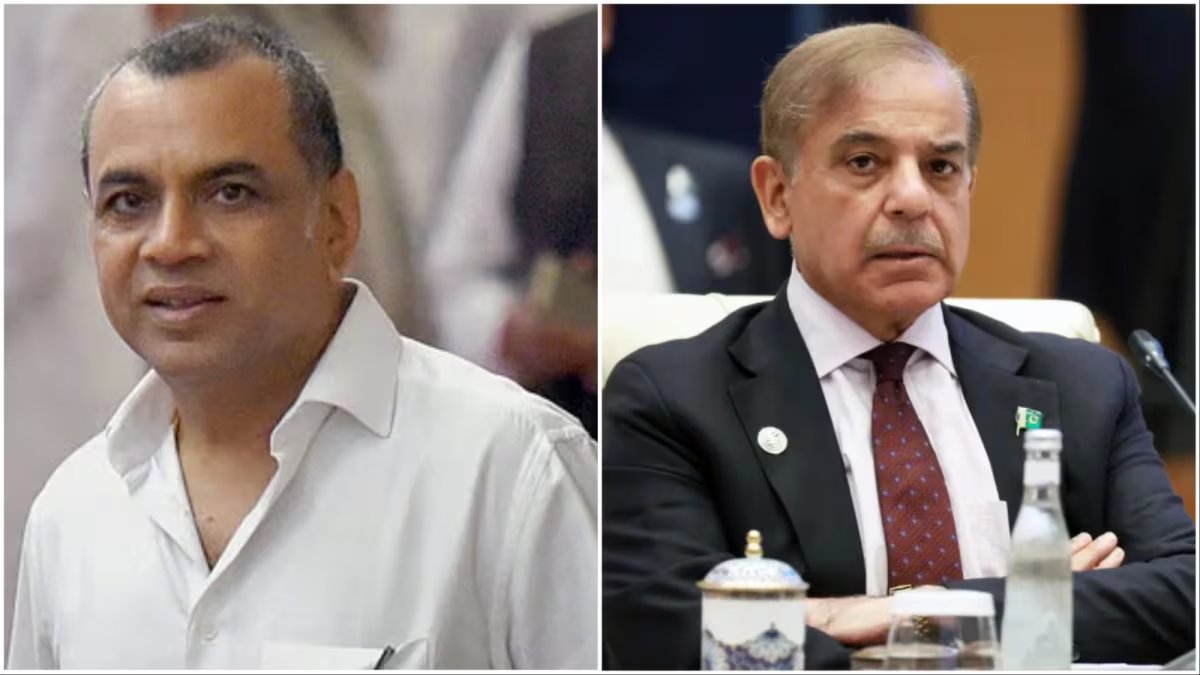
Paresh Rawal’s one-word response “IMF” to a viral post questioning who would pay the bills for Pakistan hosting US-Iran talks has caught the attention of netizens.




File photos of Paresh Rawal/Shehbaz Sharif (AP)
Veteran actor Paresh Rawal has given a sharp geopolitical twist to a viral post referencing Pakistan’s role in hosting high-level talks between the United States and Iran.
An X user joked about the costs of accommodating global leaders in Islamabad, writing, “Biggest dilemma now … hotel bills kaun clear karega?” (Who will clear the hotel bills).
The remark alluded to the expenses involved in hosting delegations for sensitive diplomatic negotiations.
Responding succinctly, Rawal wrote, “IMF”, referencing Pakistan’s long-standing financial dependence on the International Monetary Fund.
The high-stakes negotiations between Washington and Tehran were held at the five-star Serena Hotel, considered one of the most secure buildings in Pakistan’s capital.
Preparations for the meeting had transformed Islamabad into a heavily fortified zone.
Shops and offices had remained closed for two days ahead of the arrival of delegations led by US Vice President JD Vance and senior Iranian officials.
Thousands of security personnel, including paramilitary and army troops, had established checkpoints across the Red Zone, which houses key government offices and diplomatic missions.
Security experts cited the hotel’s strategic proximity to the Prime Minister’s House and Parliament, as well as its layered access points, as reasons for its selection as the venue for negotiations.
The 15-acre property, equipped with over 400 rooms and multiple conference facilities, was capable of hosting delegations comprising more than 150 officials from both sides, according to security sources quoted by Reuters.
TALKS END WITHOUT BREAKTHROUGH
The marathon negotiations lasting 21 hours did not yield a final agreement to end the conflict.
Vance said Washington had presented Tehran with its “final and best offer” but acknowledged that a key demand, a commitment that Iran would not develop nuclear weapons, had not yet been secured.
Pakistan, which mediated the talks, said it would continue facilitating dialogue between the two sides and urged them to maintain the temporary ceasefire.
The negotiations followed a period of heightened tensions triggered after US and Israeli strikes on Iran on February 28 led to retaliatory action from Tehran, escalating instability in the Middle East and affecting global markets.
US President Donald Trump also maintained that Washington had already achieved military success, asserting that the outcome of talks would not change the strategic balance.
WHY IMF REFERENCE STRUCK A CHORD
Rawal’s comment drew attention because Pakistan has historically relied heavily on IMF financial assistance to stabilise its economy.
According to reports, the IMF approved a $7 billion Extended Fund Facility (EFF) for Pakistan in September 2024, aimed at helping the country address balance-of-payments challenges and structural weaknesses in its economy.
India has previously raised concerns about repeated bailouts, noting Pakistan’s dependence on external financial support.
Pakistan has approached the IMF multiple times over several decades to avert economic crises, reflecting recurring fiscal pressures and external debt obligations.
More recently, Reuters reported that Pakistan’s foreign exchange reserves have faced pressure amid repayment obligations, including a $3.5 billion loan repayment to the UAE, which risked complicating IMF programme targets linked to maintaining reserve thresholds.
Experts note that IMF programmes typically come with reform conditions relating to taxation, energy pricing, privatisation and fiscal discipline aimed at restoring macroeconomic stability.
April 13, 2026, 13:58 IST
Read More