


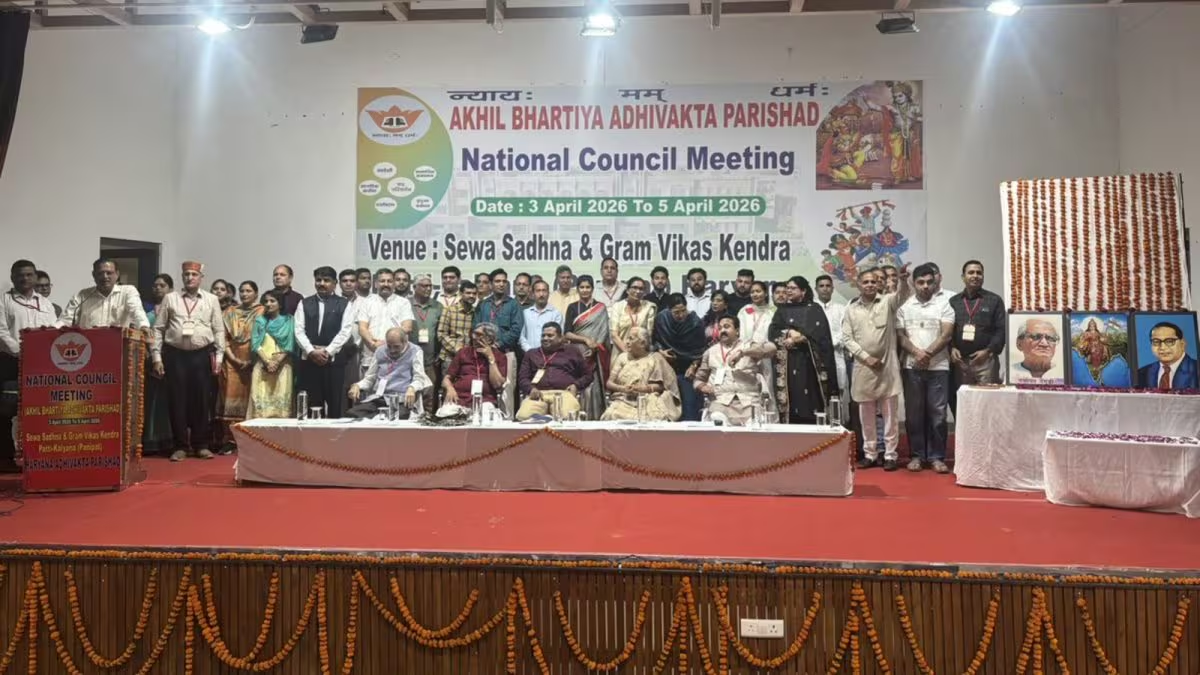
The ABAP has asked the Narendra Modi government to set up a committee to draft a bill within 60 days and place it before Parliament for consideration




The resolution has been signed by ABAP President and Senior Advocate K Srinivas Murthy. Image/X
In a move that could stir a serious debate in legal and constitutional circles, the Akhil Bharatiya Adhivakta Parishad (ABAP), the legal wing affiliated with the RSS, has passed a resolution seeking a new law to prevent former judges from testifying in foreign courts in cases seen as going against India’s interests.
The resolution was adopted at a meeting in Samalkha, Haryana. Through it, the organisation has urged the union government to bring in legislation that would bar retired judges from appearing as expert witnesses or giving testimony in overseas cases “against India”.
To make its case, the ABAP pointed to instances involving retired judges like Justice Deepak Verma, Justice Markandey Katju, and Justice Abhay Thipsay.
It noted that Justices Verma and Katju had appeared in proceedings abroad related to the extradition cases of Vijay Mallya and Nirav Modi. These cases, heard in UK courts, have drawn significant attention in India because of their links to major financial fraud allegations and the broader issue of international legal cooperation.
“Justice Deepak Verma (Retd, Supreme Court) has appeared against India’s interests in three separate foreign proceedings: the Mallya bankruptcy (evidence “unsupported in law,” to be “treated with caution”), Sanjay Bhandari in 2025, and recently in Nirav Deepak Modi v. Government of India [2026] EWHC 716 (Admin), where he opined that India’s sovereign assurances were “a diplomatic promise rather than a legally enforceable formal assurance”—an ‘expert’ testimony which, if accepted at face value could have defeated India’s extradition request,” the resolution reads.
About Justice Katju defending Nirav Modi, whom India wants extradited back, the resolution says, “Justice Markandey Katju (Retd., SC) appeared for Nirav Modi before Westminster Magistrates Court in 2021 and made serious comments painting Indian judiciary in bad light. The UK Court held his evidence was “less than objective and reliable, and that it was tinged with resentment bearing “the hallmarks of an outspoken critic with a personal agenda,” and considered his conduct of briefing journalists before testifying “astonishing” and “questionable for someone who served the Indian Judiciary at such a high level”.
The resolution doesn’t stop at calling for a ban—it also suggests tough penalties. It proposes that any former judge who violates such a law should face “automatic forfeiture of all retirement benefits, including pensions, accommodation, security” to name a few.
The resolution also asked for a parliamentary oversight committee with full powers of inquiry and adjudication.
Legal experts say such a provision, if implemented, could raise a serious constitutional clash between the executive and the judiciary that recently thwarted one over the NCERT issue where a chapter of judicial corruption irked the Chief Justice of India.
The ABAP has also asked the Narendra Modi government to set up a committee to draft a bill on the matter. It wants the draft prepared within 60 days and placed before Parliament for consideration.
The tone of the resolution is assertive. It warns that “the advocates of Bharat will not be silent”, indicating that the group plans to actively push for this legislation.
The resolution has been signed by ABAP President and Senior Advocate K Srinivas Murthy.
The proposal is likely to open up a broader debate on where to draw the line between national interest and judicial independence. Critics may see such restrictions as limiting India’s engagement with global legal processes, while supporters could argue it’s a necessary step to protect national sovereignty.
For now, it remains to be seen whether the government will take this proposal forward—and how it will deal with the legal and constitutional challenges that could come with it.
April 07, 2026, 23:28 IST
Read More