

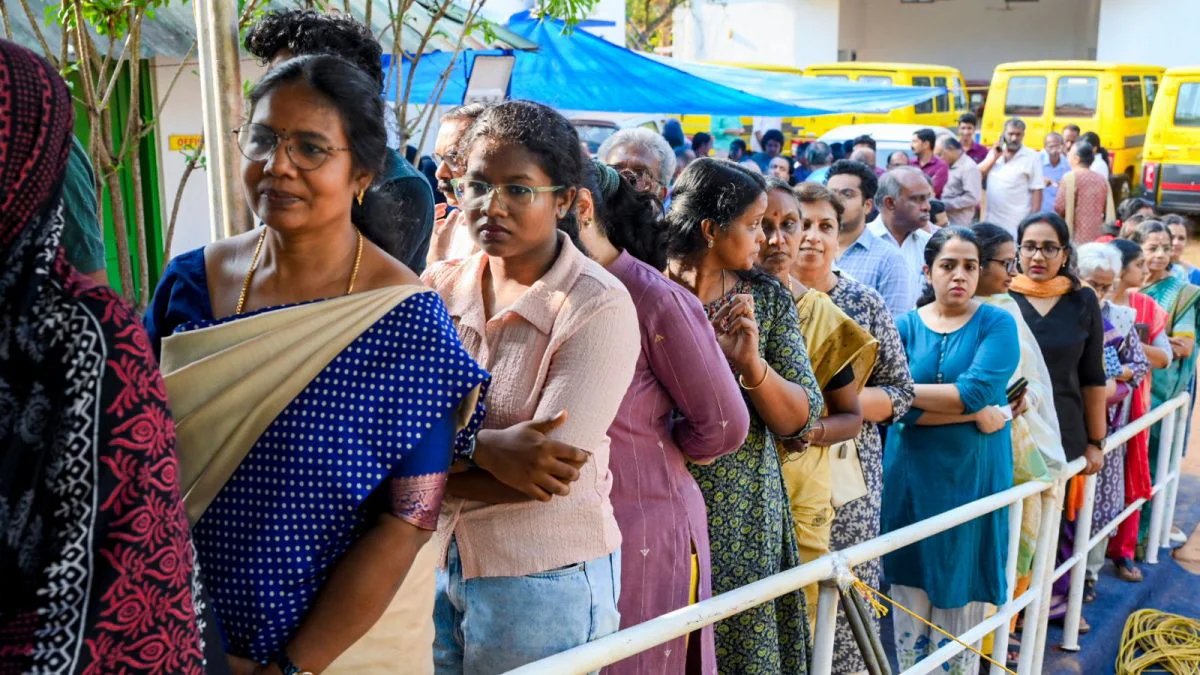
Figures released by the Election Commission of India at 7 pm showed a turnout of 77.45 percent, a notable increase from the 74.06 percent recorded in the 2021 assembly polls




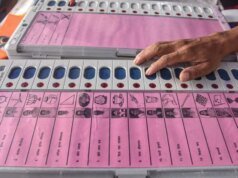
People wait in a queue to cast their vote during the Kerala assembly elections, at a polling station in Thiruvananthapuram on April 9, 2026. (Image: PTI)
As Keralam turned out to cast the ballot on Thursday, the state recorded a surge in voter turnout as compared to the 2021 assembly elections when polling ended at 6 pm.
While the final figures are not out yet, voting trends suggest a higher voter turnout for the assembly elections this time as the numbers of those who showed up at polling booths steadily grew from morning to evening.
But what does that have to do with how the state voted overall? Let’s take a look.
MORNING ‘SURGE’ OR EVENING ‘PUSH’?
Polling in Keralam took place with more than 2.71 crore eligible voters and 883 candidates. Figures released by the Election Commission of India (ECI) at 7 pm showed a turnout of 77.45 percent, a notable increase from the 74.06 percent recorded five years ago.
In a state where political literacy is high, the timing of these votes – from the early morning “surge” to the final evening “push” – is used to analyse voting trends in different constituencies and the likely result. In Keralam, the time of day a voter reaches the booth is often as telling as the vote itself.
According to experts, the early morning surge between 7 am and 11 am, is typically driven by the “committed cadre”. Strong grassroots organisations, such as the CPI(M) and the RSS-BJP, excel at early “booth management” ensuring their loyalists vote before the humid weather intensifies. A record-breaking morning turnout can signal a “silent wave” of anti-incumbency, where voters are eager to record their dissent.
Experts indicate that the midday lull from noon to 3 pm, meanwhile, helps distinguish between urban apathy and rural engagement. While urban centres like Kochi often see a dip due to the heat, sustained turnout in rural belts indicates that the working class – a core block for the Left – is turning out in force.
The evening push from 4 pm to 6 pm is frequently the domain of the undecided or neutral voter, including younger professionals. A late-day spike often favours the opposition UDF or the emerging NDA “third pole”, as per experts.
WHAT DID THE VOTING TIMELINE LOOK LIKE?
9 am: Voting started at 7 am, following which 16.23 percent turnout was recorded at 9 am. Ernakulam district led early with 17.8 percent, while Thripunithura constituency recorded a high of 20.59 percent
11 am: By the four-hour mark, participation climbed to 33.28 percent. Officials noted long queues from early morning as people sought to avoid the worsening weather
1 pm: Brisk voting continued, reaching 49.70 percent, nearly the halfway mark of the electorate
3 pm: Despite a slight afternoon slowing, the figure reached 62.71 percent. Ernakulam continued to lead at the district level with 66 percent
5 pm: As the evening push began, the turnout crossed the 75 percent mark. Kozhikode district surged ahead to record 77.63 percent, while the Kunnathunad constituency topped the state at 81.99 percent.
Chief electoral officer Rathan U Kelkar remained optimistic throughout the day, at one point suggesting that the trend could even push the final figure towards 90 percent.
SO, IS THIS REVISION OR REBELLION?
The surge in voter turnout is being widely interpreted by different political parties. Kelkar attributed much of the rise to the special intensive revision (SIR) of the electoral rolls, which removed deceased or relocated voters thereby naturally inflating the polling percentage.
This view was echoed by CPI(M) leader CN Mohanan. “As the names of people who have died or moved out have been removed, it has resulted in a rise in the polling percentage,” he said.
The opposition, however, has a different view. Congress leader Deepthi Mary Varghese said a rising percentage traditionally “turns favourable to the UDF”, suggesting a desire for change. Similarly, BJP leader KS Shaiju linked the rise to ground-level behaviour.
“Our analysis shows that more women voters have turned up this time,” Shaiju said, adding that this will benefit the BJP.
This election serves as a critical junction for Kerala’s political trajectory. For the ruling LDF, it is a test of Chief Minister Pinarayi Vijayan’s “model of governance and welfare” as they seek a rare third consecutive term. Vijayan, casting his vote in Kannur, said “people desire [the] continuation” of development.
The UDF, led by VD Satheesan, is pushing for a comeback after a decade in the wilderness, claiming there is a “strong wave for change”. Simultaneously, the NDA is attempting to shatter the state’s traditional bipolar structure. Union minister Suresh Gopi and state BJP chief Rajeev Chandrasekhar expressed confidence that the BJP will emerge as a “major force”, appealing to voters as a viable alternative to the two established fronts.
Kerala, India, India
April 09, 2026, 21:01 IST
Read More