


Kerala 2026 polls see 77.45 percent turnout, Muslim voters drift to UDF in Malabar, Christian vote splits among UDF LDF and NDA, minority shifts may decide if LDF retains power




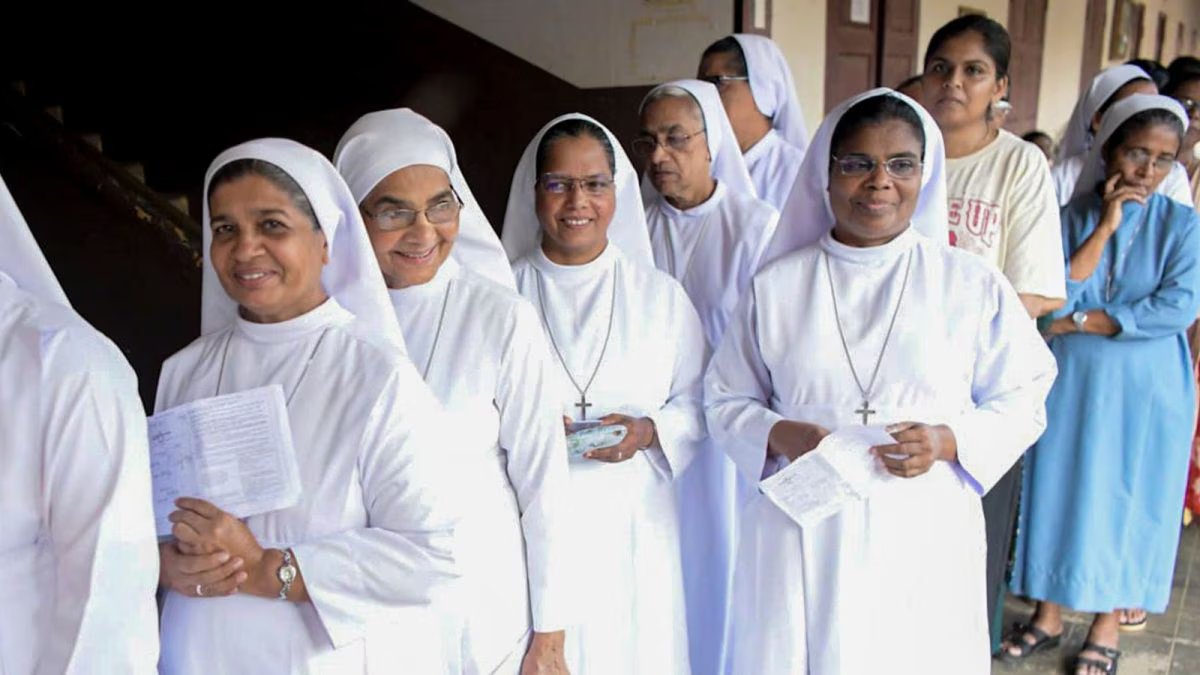
Nuns and others wait in a queue to cast votes during the Kerala assembly elections, in Alappuzha district on April 9, 2026. (Image: PTI/File)
Keralam recorded over 78 percent voter turnout on Thursday in the assembly elections, surpassing the 2021 polling percentage.
But, initial data from voting trends shows that the “minority vote pie”, which accounts for a staggering 47 percent of its population, is undergoing a significant realignment that may alter the traditional power dynamics.
The stakes have never been higher for the ruling Left Democratic Front (LDF) and the opposition United Democratic Front (UDF).
MUSLIM VOTERS IN MALABAR
The most striking trend emerging from this election cycle is the perceptible “drift” of Muslim voters in the Malabar region away from the LDF and toward the UDF. In the 2021 elections, the LDF successfully consolidated this demographic by positioning itself as the primary bulwark against national “anti-minority” narratives. However, that influence appears to have waned significantly.
Local analysts point to a growing disenchantment with the CPI(M)-led government, particularly regarding its perceived silence on controversial remarks made by certain community leaders, such as the SNDP’s Vellappally Natesan. This perceived lack of vocal support has created a vacuum that the UDF has been quick to fill. Furthermore, the political landscape in Malappuram and Kozhikode has been further charged by the open pledge of support to the UDF from groups like Jamaat-e-Islami. While the Indian Union Muslim League (IUML) remains the dominant force in the region, this new alliance has triggered high-voltage communal allegations from the LDF leadership, leading to a deeply polarised campaign.
Gender Factor And Last-Mile Mobilisation
A decisive element in this shift may be the extraordinarily high participation of women voters. Early reports from the Malappuram stronghold indicate a surge in female turnout, following a trend seen in recent local polls where participation exceeded 81%. Historically, such high engagement in these regions has favoured the UDF, suggesting that the opposition’s grassroots “last-mile” mobilisation may have effectively capitalised on local grievances.
Fragmented Christian Electorate
In stark contrast to the emerging consolidation in the north, the Christian electorate in Central and South Kerala remains deeply fragmented. Once a reliable cohesive bloc for the UDF, this community is now divided by historical denominational disputes and strategic outreach from other players.
The long-standing Malankara Church dispute between the Jacobite and Orthodox factions continues to dictate the political weather in specific constituencies. While the LDF has attempted to mediate these disputes to gain a tactical advantage, the UDF has sought to regain ground by leveraging its momentum from the 2025 local body elections. Simultaneously, newer political constituencies, such as Pentecostal and Neo-Christian groups, are emerging with a distinct tilt toward the Left, seemingly drawn by the government’s promises of local social security and welfare initiatives.
NDA As ‘Third Force’
Adding a further layer of complexity is the strategic intervention of the BJP-led NDA. By specifically targeting the Christian community in districts like Kottayam and Pathanamthitta, the NDA has turned several contests into genuine three-way battles. Even a nominal shift of 3–5% of minority votes toward the NDA in “marginal” seats could act as a spoiler for the UDF. Paradoxically, this fragmentation of the opposition vote could provide a lifeline to the LDF, helping them retain power despite facing local anti-incumbency.
Welfare Vs Political Narrative
The final result will likely serve as a referendum on whether the LDF’s welfare-focused “progress report” can withstand the opposition’s concentrated push. The ruling government has campaigned heavily on its record, claiming a 97% completion rate of its 2021 election promises.
Ultimately, these voting trends indicate that in a state where margins are traditionally thin, small shifts in minority support will likely determine which coalition forms the next governing body. Whether the UDF’s consolidation of the Malabar vote is enough to offset the fragmentation of the Christian heartlands remains the central question as Kerala awaits the final count.
Kerala, India, India
April 10, 2026, 00:59 IST
Read More