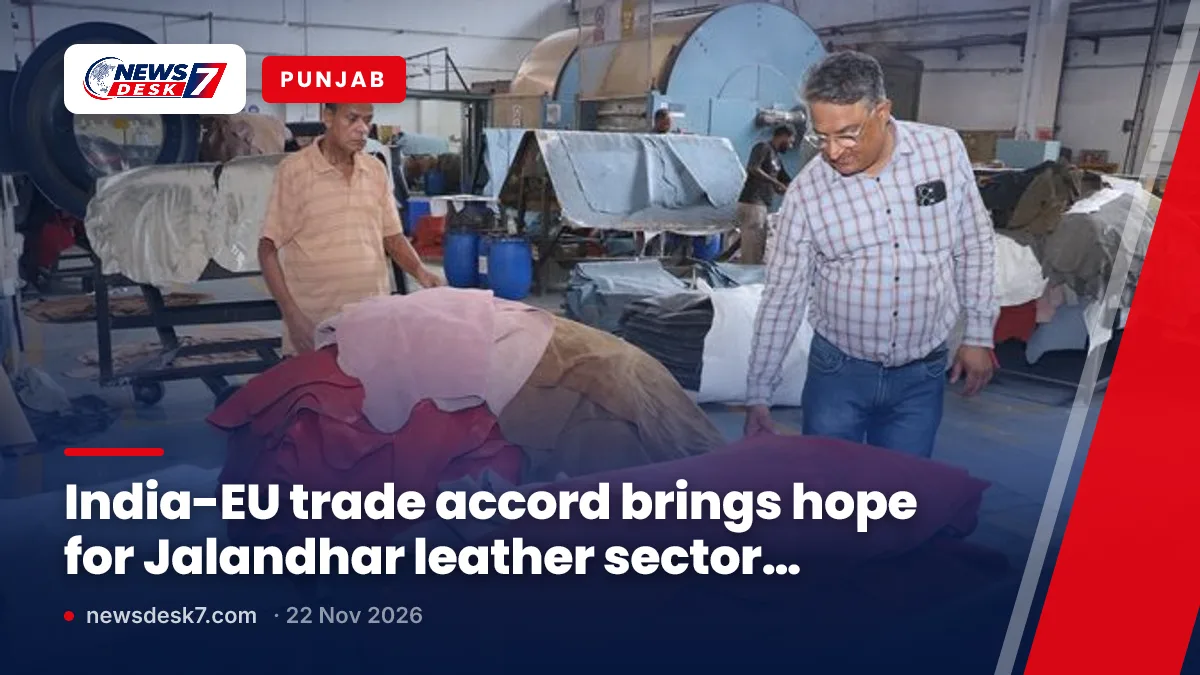
After a decade of shrinking exports, Jalandhar’s leather industry is looking to the India-European Union Free Trade Agreement (FTA) for a revival, banking on tariff concessions to regain ground in its conventional European market. Annual exports from the cluster have fallen from approximately Rs 1,000 crore in 2015-16 to Rs 250 crore at present, leaving 59 operating units hoping that improved market access will translate into fresh orders.
“Europe has traditionally been the biggest market for Jalandhar’s leather industry. The removal of the 17 per cent tariff can make our products more competitive and help us recover lost business,” states Amandeep Sandhu, president of the Punjab Leather Federation (PLF).
The cluster manufactures leather garments, handbags, footwear, gloves, sports balls, tool bags, yoga mats and medicine balls for fitness. Its products, made from cow, buffalo, sheep and goat hides, reach European markets including Germany, Spain, Italy, France and the Netherlands. Some units supply global brands, including Zara, H&M, Marks & Spencer and Adidas. Yet, tariff relief alone may not reverse the decline. Competitiveness will also depend on product quality, environmental compliance and the ability to meet evolving buyer requirements.

The anticipated boost comes as the cluster’s infrastructure begins to improve. The 220-acre Leather Complex, formed in 1992, houses common amenities, including a Common Effluent Treatment Plant (CETP), which was upgraded two months ago. A regional centre of the Central Leather Research Institute (CLRI), formed within the complex in 1996, supplies technical support and conducts chemical, physical and environmental testing.
“We keep guiding the industry to follow the norms prescribed under the EU’s Registration, Evaluation, Authorisation and Restriction of Chemicals (REACH) regulation. We get some tests done for them locally, but samples for testing chrome, arsenic and other heavy metals are sent to our Chennai centre,” says Dr P Sudhakara, Scientist E at CLRI, Jalandhar.
Sandhu, who bought the first plot in the complex and commenced operations in 1992, says the sector grew during its first 15 years before faltering amid inadequate administration support and infrastructure. Production has commenced picking up again, he says, with the CETP upgrade addressing a key environmental requirement.
Sachin Behal of the Council for Leather Exports, Jalandhar, also sees the trade accord and upgraded infrastructure as reasons for renewed optimism. The cluster, he says, has lost almost three-fourths of its export business over the past decade.
Negotiations for the India-EU FTA were wrapped up on January 27, 2026. Exporters are also looking to the UK, already a key market, while hoping the pact with the EU will open up further opportunities.
For Jalandhar’s manufacturers, the challenge is to remain price-competitive while meeting increasingly strict European standards on chemicals, traceability and production processes. The shift towards chrome-free leather is one example of how enhanced market access will depend on adapting to buyers’ preferences.
Gaurav Sud, owner of Jalandhar-based Prime Banox, notes European buyers have varying requirements. “My company makes women’s purses, garments and sleeping bags using cow, buffalo and sheep leather. While some EU buyers demand chrome-tanned leather, others seek chrome-free alternatives. We use chemical alternatives such as aldehydes for chrome-free tanning.”
Chrome tanning, however, remains popular because it is fast, versatile and cost-effective. Tanners say they use chromium III and take precautions to stop its conversion into hazardous chromium VI. These include keeping treated hides wet and storing them away from direct sunlight. Chrome recovery procedures are also followed to stop the excessive use of chromium during treatment.