




















Last Updated:
The Central Committee and Politburo of the CPI(Maoist), which had 21 members at the start of 2024, had none left standing by March 2026.


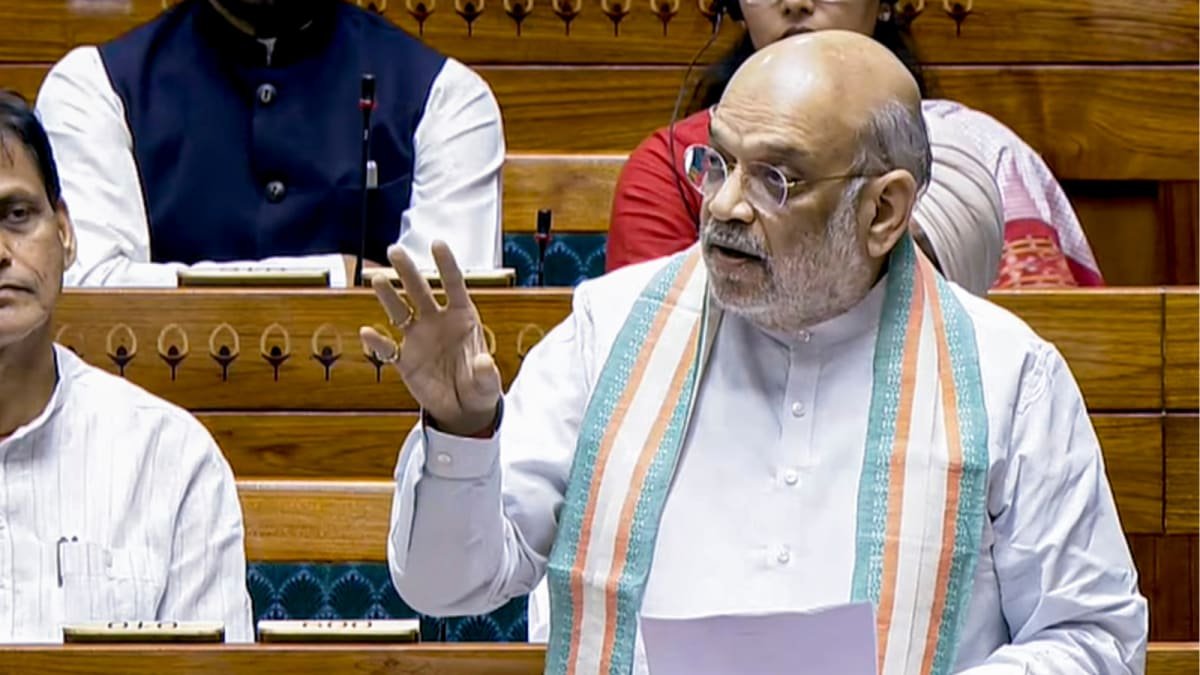
Home Minister Amit Shah speaks in Parliament. (Image: PTI)
On March 30, 2026 — one day before the Centre’s self-imposed deadline — Union Home Minister Amit Shah stood in the Lok Sabha and spoke for close to 90 minutes in what will go down as perhaps his most emotive, unsparing and aggressive speech as parliamentarian. By the time he sat down, he had made a claim few governments in Indian history have been able to make about a decades-old, rancidly violent insurgency: Naxalism is dead.
The numbers he cited were hard to argue with. The Central Committee and Politburo of the CPI(Maoist), which had 21 members at the start of 2024, had none left standing by March 2026. All 37 state committee members across the Dandakaranya region — the Maoist heartland — had been killed, arrested, or had surrendered. In 2014, Naxalism touched 126 districts. By 2025, only 11 districts reported any presence at all, and just three of those were classified as most-affected. Violent incidents had dropped by 53 per cent. Deaths of security personnel were down 73 per cent. Civilian fatalities had fallen 70 per cent.
But rattling off statistics doesn’t explain how one of India’s most entrenched insurgencies — once described by Prime Minister Manmohan Singh as the country’s gravest internal security threat — came apart the way it did. That story is more interesting, and considerably more complicated.
The Jungle Fighters
Start with the unit most people haven’t heard of. The Commando Battalion for Resolute Action — CoBRA — was raised between 2008 and 2009 under the Central Reserve Police Force, and from the beginning it was built for a specific purpose: guerrilla warfare in terrain that had swallowed conventional police operations whole.
Ten battalions, roughly 10,000 personnel. Training facilities in Belgaum and Koraput where CRPF men learned explosive tracking, bomb disposal, field engineering, fast-roping, intelligence gathering, and how to simply survive in the dense forest cover of Bastar, Abujhmad and the tri-junction areas where state boundaries dissolve and Maoists had moved freely for years. Since its founding, CoBRA launched over 39,000 operations, killed 636 Naxals, arrested 3,992, and secured the surrender of 3,367 more. Forces recovered 1,858 weapons, over 64,000 rounds of ammunition, and upward of 9,600 bombs and IEDs.
Many CoBRA personnel died doing this work. That’s worth sitting with for a moment.
The Locals Who Changed the Game
Specialised central forces could go places regular police couldn’t. But the deeper breakthrough came from a different direction entirely — from men who already knew those forests because they’d grown up in them.
Chhattisgarh’s District Reserve Guard (DRG), formed in 2008, recruited directly from local and tribal communities – mostly surrendered Nazals. The logic was straightforward: the Maoists had built their base among these communities and claimed to speak for them. The DRG put people from the same villages into uniform and gave them counter-insurgency training. By 2015, the force had expanded from its original two districts — Kanker and Narayanpur — to Bijapur, Bastar, Sukma, Kondagaon and Dantewada. Its roughly 3,500 personnel knew these forests the way no outsider could.
Some of them knew more than that, since a significant portion of DRG recruits had been Naxals themselves. After surrendering, they joined the constabulary and, after a period of observation, some rose to the rank of inspector. These weren’t just symbolic gestures toward rehabilitation. Former Maoists provided precise, granular intelligence — on hideouts, supply routes, command structures — that no external intelligence officer could have generated on their own. In 2024 alone, 64 state committee members surrendered in Bastar. The Maoist area of influence in that district shrank from 20,000 square kilometers to 4,000.
The DRG’s most consequential moment came on May 21, 2025, when operations in the Abujhmarh forest killed Nambala Keshava Rao — known by his nom de guerre Basavaraju — the General Secretary of the CPI(Maoist) and the movement’s highest-ranking figure. His death effectively decapitated the organisation’s command structure.
The Intelligence Overhaul Nobody Talks About
None of the operational success would have been possible without a quieter transformation happening in parallel.
The CRPF activated its intelligence wing to map Jan militia members, Revolutionary People’s Committees and Maoist support networks at the ground level. Each battalion was assigned a dedicated intelligence unit. Officers went into villages, built relationships, and worked to persuade cadres that there was another option. IPS officers began rotating between state police, the Intelligence Bureau, CRPF and intelligence desks — creating the kind of institutional crossover that had been conspicuously absent before.
Real-time intelligence flows changed what operations could do. Precision strikes became more common. IED ambushes, which had killed so many security personnel in earlier years, became harder to execute. District SPs exercised operational control when Central Armed Police Forces deployed, ensuring that the old problem of competing command structures was at least being managed if not entirely eliminated.
Giving Maoists a Way Out
Running alongside the security campaign was something arguably just as important: an exit ramp.
Chhattisgarh’s “Poona Margham: Punarvas Se Punarjeevan” scheme offered cash incentives for surrendering, bonuses for turning in weapons, employment assistance and a pathway back into civilian society. The “Niyad Nellanar” scheme promised 25 basic amenities to villages within five kilometers of security camps, making the tangible argument that the government could actually deliver things the Maoists had actively tried to hijack.
States got competitive about it. Odisha set its reward rates 10 percent higher than Chhattisgarh’s. The numbers at the top of the Maoist hierarchy were striking: Central Committee or Politburo members who surrendered received Rs 1.10 crore; state committee members got Rs 55 lakh; regional members Rs 33 lakh. Between November 2025 and February 2026, 45 cadres surrendered in Odisha alone, claiming Rs 6.5 crore in benefits. In December 2025, 34 Naxals carrying Rs 84 lakh in combined reward value laid down arms in Bijapur.
Look at the trajectory: 376 surrenders in 2023. 881 in 2024. 2,337 in 2025 — a 165 percent jump. The first quarter of 2025 alone produced 280 surrenders, more than double the 124 from the same period a year earlier. At some point, a movement begins to unravel not because of military pressure alone but because enough of its members decide the fight isn’t worth continuing.
Roads, Towers, and the Administrative Void
Shah’s broader strategy rested on a diagnosis that previous governments had either missed or chosen not to act on: Naxalism didn’t survive in poverty alone. It survived in administrative absence. In places where the state had simply never shown up.
The Aspirational Districts Programme, launched in January 2018, targeted 112 underdeveloped districts — 35 of them Naxal-affected — and tried to change that, using health, education, agriculture, financial inclusion and infrastructure as its levers. More concretely, the government sanctioned over Rs 20,000 crore for 17,000 kilometers of roads in Left Wing Extremism-affected areas across two road construction phases, with over 12,000 kilometers actually built on the ground. It approved 8,527 4G towers, with over 5,000 operational. Security forces built 586 fortified police stations, up from just 66 before 2014, and established 361 new security camps and forward operating bases since 2019.
Roads brought administrators, teachers and health workers into villages that had been effectively off the map. Mobile towers meant communication was finally possible and within reach of the ordinary people. Security camps meant the state was there permanently, not just in occasional raids. Development followed security, and security held because development was finally following.
What Changed in Chhattisgarh
The BJP’s election victory in Chhattisgarh in December 2023 was, in retrospect, the operational turning point.
Under the Congress government of Bhupesh Baghel, coordination between the state and the Centre had been inconsistent. The BJP’s position was blunt: Naxal incidents had risen during Baghel’s tenure. The April 2023 Dantewada attack — which killed 10 policemen and a civilian driver — made the security situation impossible to soft-pedal.
When Vishnu Deo Sai took office, the “double engine” framework that Shah had been advocating — Centre and state governments aligned and coordinating — actually began to function as described. Between December 2023 and May 2025, security forces neutralised 401 Maoists, arrested 1,429 and secured the surrender of 1,355. In the first year alone, 2,619 Naxalites were killed, arrested, or had surrendered.
Shah’s own framing of this was pointed: same state, same police, same central forces. The one variable was political will and coordination. Operation Black Forest, which ran from April 21 to May 11, 2025 in the Karreguttalu Hills, illustrated what that combination could produce — 31 Naxals killed without a single security casualty.
The Man Behind the Mission
Amit Shah had set this in motion almost from the day he took office. On August 20, 2019, he convened a meeting on rehabilitation and reintegration and gave himself a deadline: March 31, 2026. Then he worked backward.
He pushed states to rebuild their police forces. He reformed intelligence protocols. He targeted Maoist leadership at every tier of the hierarchy. He directed operations into the Abujhmad region — the deepest Maoist stronghold — which had been effectively avoided for years. More symbolically but not insignificantly, he had over 100 Maoist memorials demolished, dismantling the physical iconography of Maoist control. And critically, he insisted that once areas were cleared, development inputs had to follow immediately so the vacuum couldn’t be filled again.
Prime Minister Modi gave him the latitude to see it through. Shah used it.
When he stood in the Lok Sabha on Monday, the philosophy he articulated was unambiguous: talks for those who lay down arms, force for those who use them. He credited not poverty but left-wing ideology for the insurgency’s persistence. He made political accusations — that opposition parties had sympathised with Naxals while ignoring their victims. And he declared that by the following day, India would be Naxal-free.
The data, for once, backed the declaration.
What India ultimately built wasn’t a single program or a single force. It was an architecture — specialised units that could operate in hostile terrain, intelligence systems that actually shared information, surrender schemes generous enough to be taken seriously, state police rebuilt around local knowledge, infrastructure that made governance possible where it had previously been absent, and political leadership willing to treat the problem as something that could actually be solved. The Red Corridor didn’t shrink because of one decisive battle. It collapsed because the state finally decided to be present in the spaces it had spent decades ceding.
March 31, 2026, 13:14 IST
Read More