









Last Updated:
Tamil Nadu’s major political parties have unveiled manifesto promises blending welfare schemes such as cash assistance and subsidies with development-focused commitments on jobs.




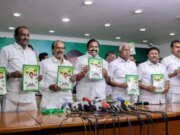
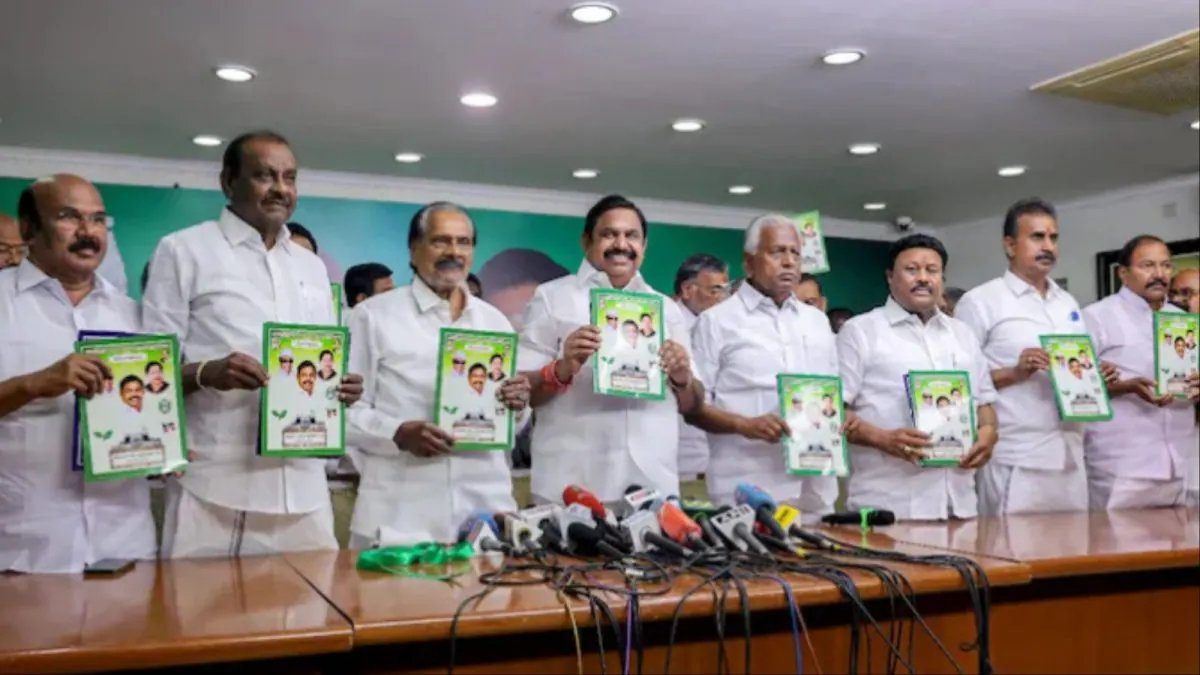
AIADMK chief Edappadi K Palaniswami (centre) with others releases the party’s manifesto ahead of the state Assembly elections (Photo: PTI)
As Tamil Nadu heads towards the April 23 Assembly elections, political parties have unveiled manifesto promises that reflect a familiar electoral debate, welfare “freebies” versus long-term development commitments.
From direct cash transfers and subsidised essentials to infrastructure expansion and economic growth plans, parties are attempting to balance immediate voter relief with broader governance visions.
Major players, including the DMK, AIADMK, BJP, Congress and Naam Tamilar Katchi (NTK) have placed welfare schemes for women, farmers, students and low-income households at the core of their electoral pitch.
At the same time, parties have also highlighted investment, employment and infrastructure proposals to position themselves as proponents of development-led governance.
AIADMK PROMISES CASH SUPPORT AND SUBSIDIES
AIADMK General Secretary Edappadi K Palaniswami released a manifesto containing 297 promises, with a strong focus on financial assistance and subsidies aimed at easing the cost of living.
The party has promised Rs 2,000 monthly assistance to female heads of households under the proposed ‘Kula Vilakku Scheme’, along with a one-time Rs 10,000 relief per family to address rising prices and tax burdens.
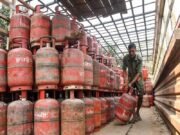
The manifesto also proposes three free LPG cylinders annually for ration card holders, distribution of refrigerators, provision of lentils along with rice through the public distribution system, and extension of free bus travel schemes to men.
Additional proposals include farm loan waivers, solar panel subsidies and expansion of healthcare coverage.
AIADMK has argued that the measures are aimed at reducing financial pressure on households facing rising prices of essential commodities and higher utility charges.
DMK FOCUSES ON CONTINUITY OF WELFARE MODEL
Chief Minister MK Stalin unveiled the DMK manifesto, emphasising the continuation and expansion of existing welfare programmes.
Key announcements include increasing financial assistance for women under the Kalaignar Magalir Urimai Thittam from Rs 1,000 to Rs 2,000 and expansion of the breakfast scheme for school students up to Class 8.
The manifesto also proposes enhanced pensions for senior citizens and persons with disabilities, increased student assistance under education schemes, housing expansion and employment generation through large-scale investment commitments.
According to recent reports, the DMK has also proposed appliance purchase support for homemakers and job creation initiatives aimed at generating employment for lakhs of youth, positioning welfare alongside economic growth priorities.
CRITICISM OVER ‘FREEBIES’ POLITICS
The AIADMK’s announcements drew criticism from DMK leaders, who alleged that the promises were designed to influence voters through financial incentives rather than governance outcomes.
DMK leader TKS Elangovan claimed that such assurances were an attempt to “mislead people” and questioned their feasibility.
Political rhetoric has intensified as rival parties accuse each other of relying excessively on welfare incentives instead of structural reforms.
Critics argue that excessive reliance on subsidies may strain public finances, while supporters contend that social assistance schemes play a key role in reducing inequality and improving living standards.
NTK PUSHES SELF-RELIANCE AND ECOLOGICAL MODEL
Naam Tamilar Katchi (NTK) has attempted to differentiate itself by presenting a governance model focused on environmental sustainability and self-reliance.
The party has proposed declaring agriculture a “National Occupation”, expanding cold storage infrastructure, promoting natural farming and restoring water bodies using traditional techniques.
NTK has also proposed a zero-waste industrial ecosystem through “Cycling Parks”, Tamil-medium education reforms and incentives for waste segregation.
The party has emphasised local resource utilisation and ecological preservation as part of its economic vision.
ALLIES HIGHLIGHT SOCIAL JUSTICE AND INCLUSIVE DEVELOPMENT
BJP leader Tamilisai Soundararajan stated that the party’s manifesto will focus on social justice, women’s empowerment and farmer welfare, while Congress leaders said their manifesto would reflect public consultation inputs and provide a roadmap for the next five years.
Congress leader Karti Chidambaram indicated that the party is preparing both a detailed manifesto and a simplified version designed to communicate key promises concisely to voters.
DEVELOPMENT VS DIRECT BENEFITS EMERGES AS KEY THEME
With voting scheduled in a single phase and counting set for May 4, the electoral contest is expected to revolve around competing visions of governance.
While welfare schemes such as cash transfers, subsidies and free services continue to play a significant role in Tamil Nadu’s political landscape, parties are also attempting to highlight infrastructure expansion, employment generation and economic investment plans.
The debate over freebies versus development is likely to remain central to the campaign narrative, as parties seek to convince voters that their policy mix offers both immediate relief and long-term growth.
April 01, 2026, 13:14 IST
Read More