


Despite moving from a modest Gujarat Housing Board home in Jamnagar’s Ranjitnagar area to the grand Bungalow No. 10 on Akbar Road, Tushar Mehta remains humble and grounded




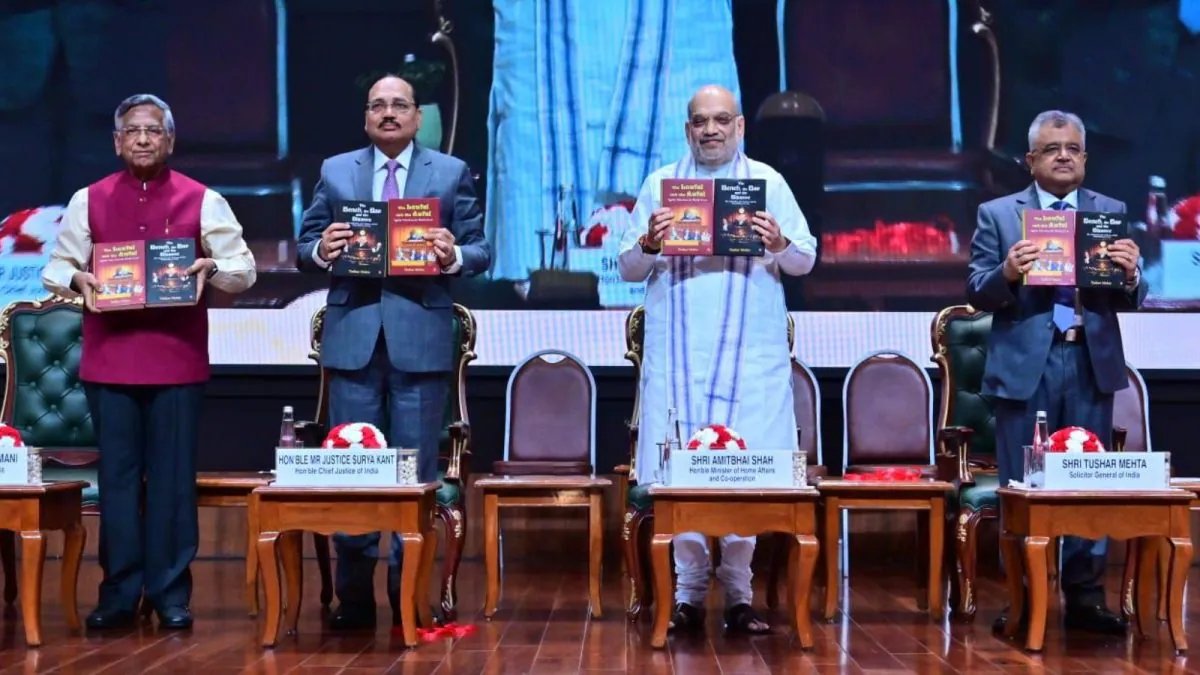
(From left) Attorney General R Venkataramani, CJI Surya Kant, Home Minister Amit Shah and Solicitor General Tushar Mehta at the book launch.
Over the past eight years, Tushar Mehta has left a deep impact as India’s Solicitor General. He is known not only for strongly representing the Modi government in the country’s highest court, but also for his calm demeanour, humility, and his ability to present facts in a refined and effective manner.
On Sunday evening, two books authored by Tushar Mehta were formally launched at Bharat Mandapam in Delhi. The event was chaired by Chief Justice of India Justice Surya Kant, while Union Home and Cooperation Minister Amit Shah was the chief guest.
The occasion was attended not only by Mehta’s family members, but also by Amit Shah’s wife Sonalben and daughter-in-law Rishita. Shah spoke about his relationship with Tushar Mehta. He also mentioned Mehta’s mother, to whom both the books have been dedicated. In the dedication, Mehta writes that his mother’s struggles and sacrifices played a major role in helping him reach where he is today.
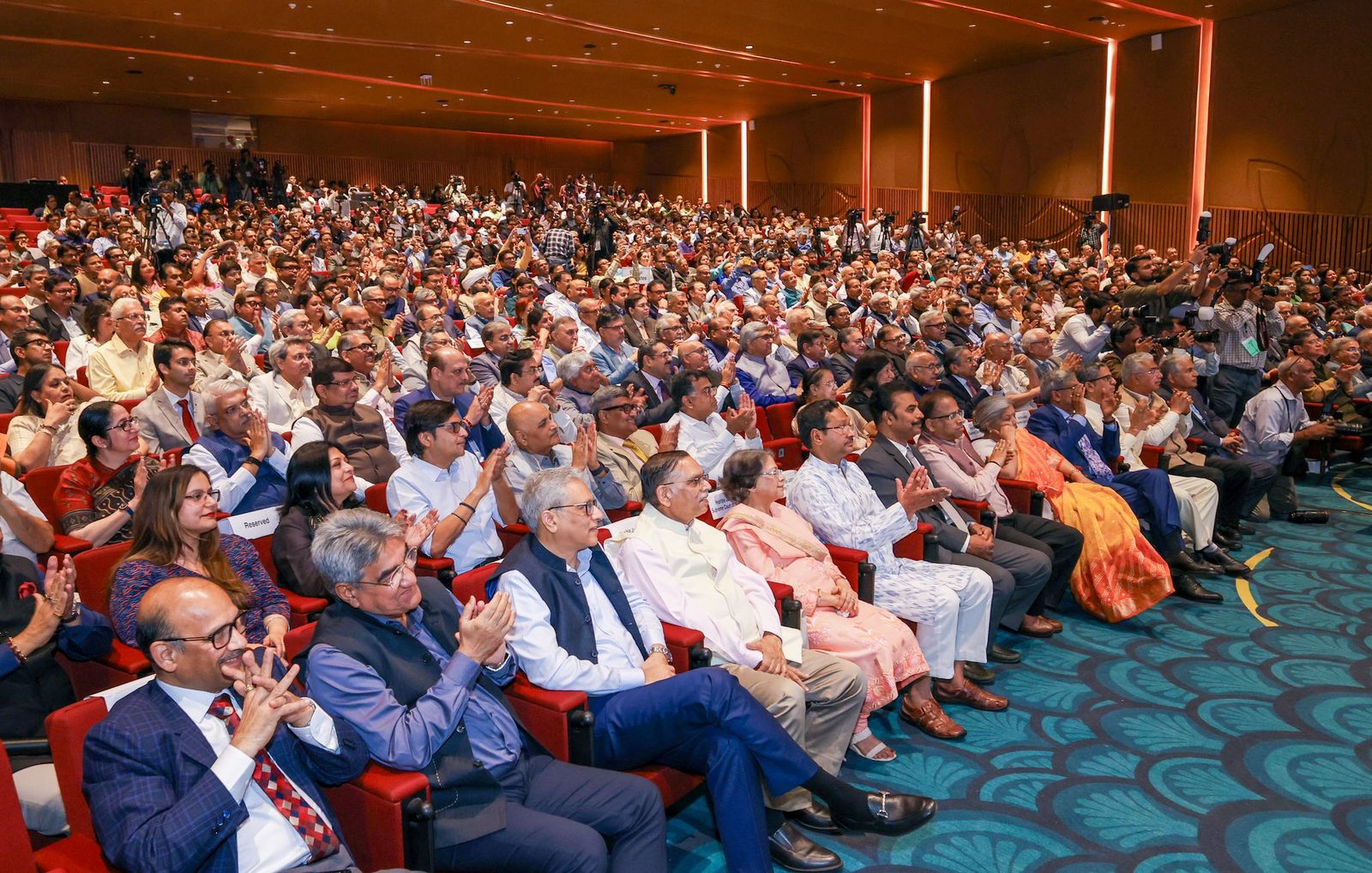
Naturally, there could hardly have been a better day than Mother’s Day for the launch of the two books. Despite it being a Sunday evening, the event saw the presence of many distinguished personalities not only from the legal fraternity but also from other sections of society. Along with Supreme Court judges, several Chief Justices from different states, other judges, and senior advocates gathered at Hall No. 2 of Bharat Mandapam.
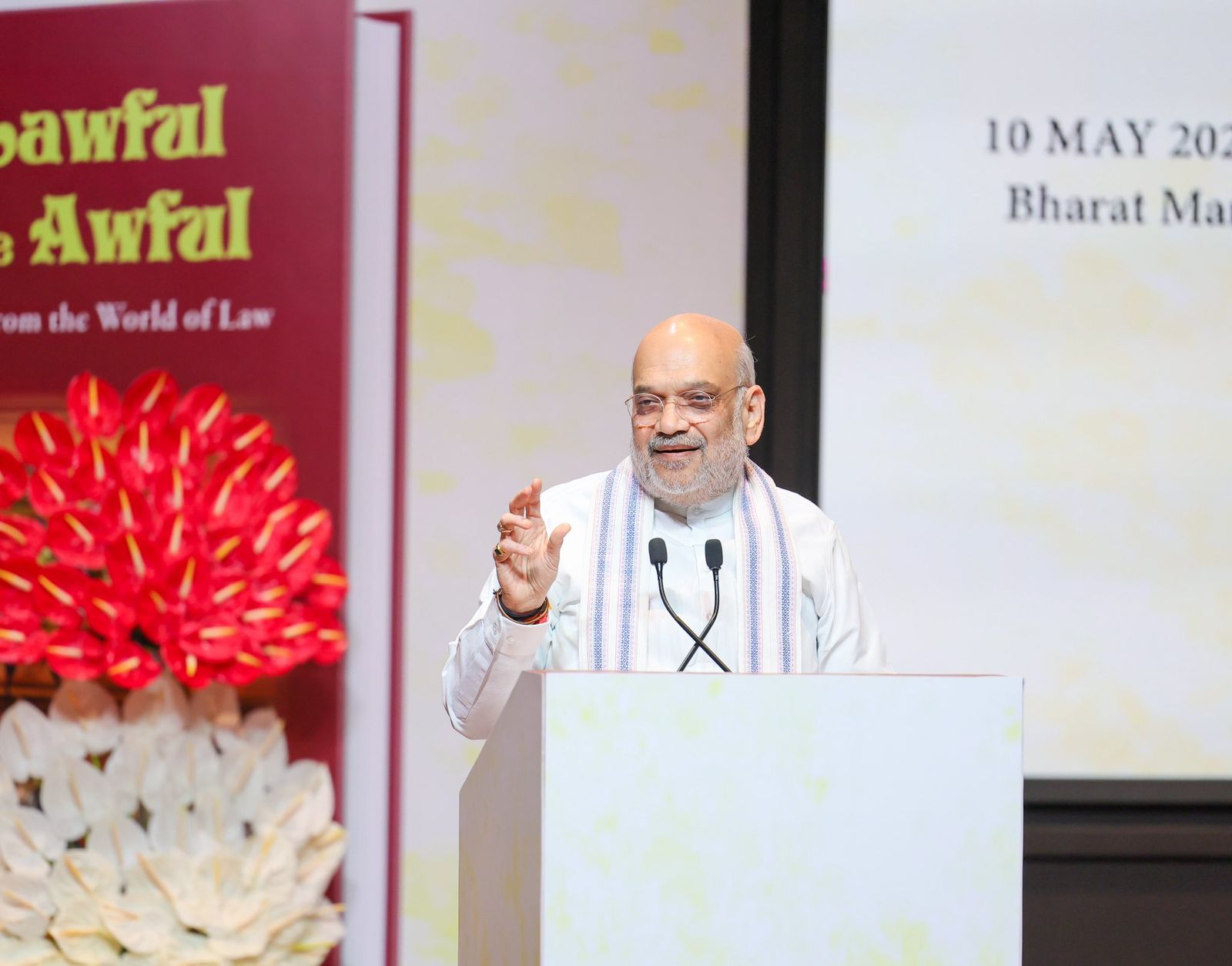
The stage represented a rare coming together of both the judiciary and the executive. However, Shah made it clear at the outset that he would not speak about issues concerning these institutions at the event. He said there would be other forums for such discussions, and that he was there solely to celebrate and discuss his friend Tushar Mehta’s books.
And that is exactly what he did — spending most of his speech talking about Mehta and his writings. Attorney General R. Venkataramani did the same. Having thoroughly read the books, he elaborated on their many aspects one after another, almost in the style of presenting arguments in court after preparing for an important case.
Chief Justice Surya Kant wholeheartedly praised Tushar Mehta for authoring both books, while also teasing him for not including stories from Indian courts. The Chief Justice suggested that Mehta’s third book should focus on interesting anecdotes from the Indian judiciary. He even narrated several amusing courtroom stories that could inspire such a future book.
THE TWO BOOKS
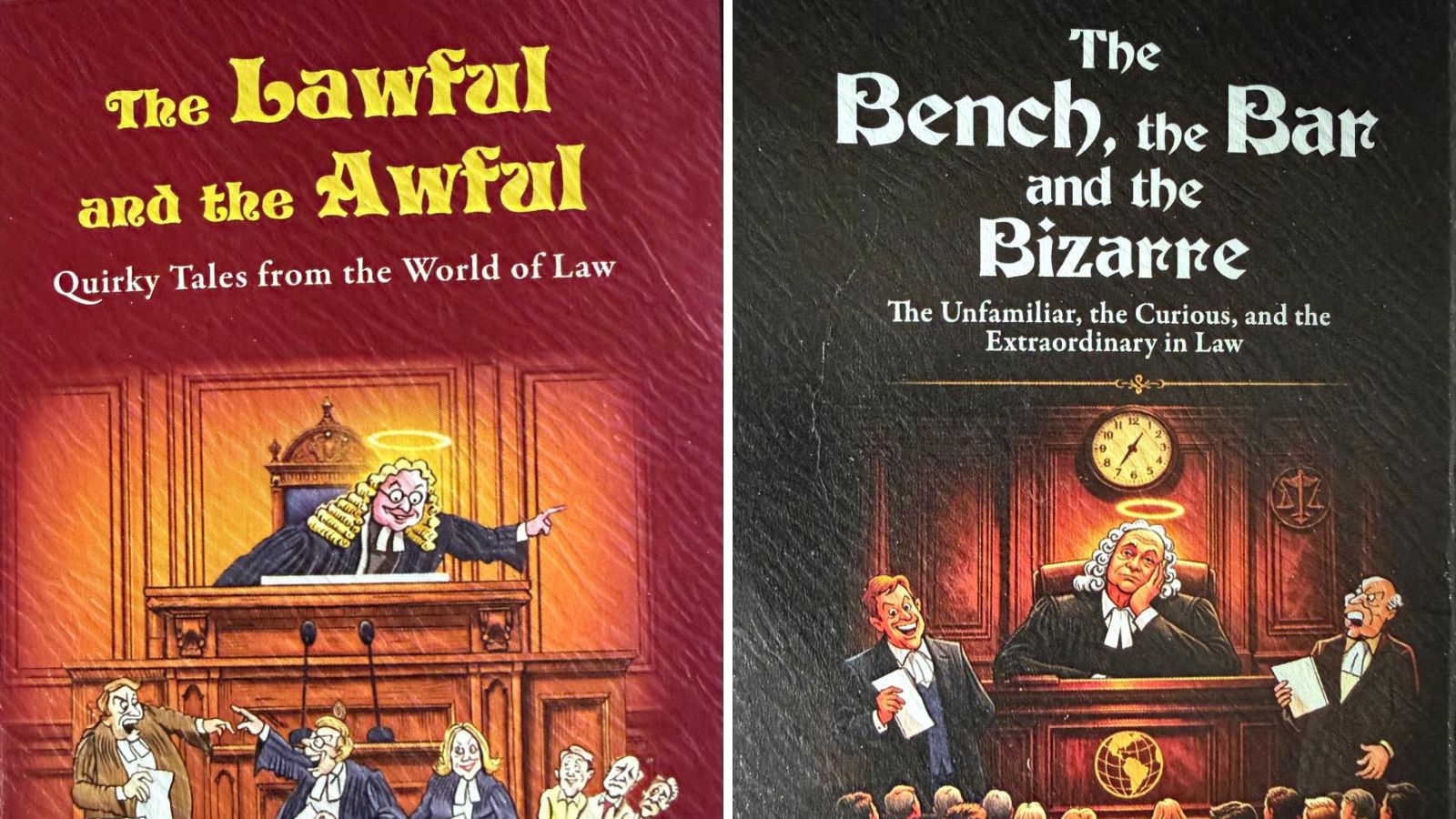
The two books written by Mehta are titled ‘The Bench, the Bar and the Bizarre’ and ‘The Lawful and the Awful’. As the titles suggest, these are not conventional law books. Instead, they take an unconventional approach, offering candid observations on the judiciary and legal system. Most of the stories featured in the books are drawn from foreign courts, particularly American courtrooms.
These books describe how some judges begin to see themselves as almost god-like figures, while also portraying the struggles, helplessness, and dilemmas faced by lawyers, litigants, and even judges themselves. The books contain many fascinating anecdotes ranging from district courts to the Supreme Court.
Mehta himself explained in a light-hearted manner why he chose not to centre the books around the Indian judicial system and Indian courts. He said that he still has many years of legal practice ahead of him, which is why he avoided directly discussing Indian courtrooms.
Another reason, he explained, was that through these stories he wanted to show that courts and judgments in other countries are not necessarily better than India’s judicial system, contrary to what many people believe. However, after the suggestion made by Chief Justice Justice Surya Kant, many people present in the packed hall felt that Mehta may come out with a third book with stories of Indian courts.
Usually, when a prominent lawyer or judge writes a book, it is either an autobiography or a detailed account of famous legal battles, constitutional questions, and related issues. But Tushar Mehta chose a different path. With candour and wit, he raised issues and narrates stories that both amuse readers and provoke questions about the judicial system. That is what makes both books unconventional.
MEHTA’S JOURNEY
In fact, Mehta’s own life journey has also been unconventional. Tushar Mehta is the longest-serving Solicitor General of India after CK Daphtary. Yet, he does not come from any major legal dynasty. It is often believed that belonging to a family of lawyers is advantageous for reaching the top in the legal profession, but Mehta is the first lawyer in his family.
His early education did not take place in major metropolitan cities like Mumbai or Delhi, but in the city of Jamnagar in Gujarat. The city was once known mainly for famous cricketers like Ranjitsinhji and Duleepsinhji, and today is recognized as an important industrial and strategic hub. It was in Jamnagar that Tushar Mehta spent his childhood.
Born on September 11, 1964, Mehta lost his father at a very young age. Just a few days before his matriculation examinations were to begin, his father — who worked as a Mamlatdar in the Gujarat government — died in an accident. Despite this tragedy, Mehta did not abandon his exams. He continued his studies while silently carrying the grief of losing his father.
Mehta completed his higher secondary education in science from DCC High School in Jamnagar. At the time, he aspired to become an engineer. His dream was to contribute to the speedy completion of the long-delayed Sardar Sarovar Dam on the Narmada River, which had long been seen as a major hope for solving the water crisis in the Saurashtra region.
But fate had different plans for him. After his father’s death, the family faced severe financial difficulties. Mehta himself mentions this in his book. He writes that after his father passed away when he was only thirteen, his widowed mother sold her jewelry to fund his education and ensure he could continue his studies.
Despite these financial challenges, Mehta completed his Class 12 education. However, despite extensive preparation and hard work, he was unable to secure admission to a reputed engineering college. As a result, he decided to pursue a B.Sc. degree from DKV Arts and Science College in Jamnagar.
After completing his B.Sc. in 1983, Mehta moved to Ahmedabad, the largest city in Gujarat. At one point, he considered preparing for the UPSC examination and joining the civil services, especially since his father had served in the Gujarat government’s administrative system. But soon afterward, he decided to make law his profession.
Tushar Mehta enrolled at the renowned Sir L. A. Shah Law College in Ahmedabad and also lived in its hostel. It was considered one of the most prestigious law colleges in western India. Established on June 20, 1927, by the Gujarat Law Society, it was the fourth-oldest law college affiliated with the University of Bombay.
The law college became part of the Gujarat University, which was established in 1949, in 1950.
The institution produced two Chief Justices of India — Justice J. C. Shah and Justice A. M. Ahmadi — along with numerous Supreme Court and High Court judges.
After gaining admission to this highly accomplished institution, Tushar Mehta devoted himself wholeheartedly to his LL.B. studies. As a result, he earned not one but five gold medals during his law degree. Three of these medals were awarded by Gujarat University, while two came from the Gujarat Law Society. Two medals were named after Justice N. G. Shelat and Nani Palkhivala.
After completing his LL.B. with distinction, Tushar Mehta registered as an advocate with the Gujarat Bar Council on March 9, 1987, obtaining his legal license. He then began practicing law at the Gujarat High Court. In his early years, he worked as a junior under noted lawyer Krishnakant Vakharia. After some time, Mehta started his independent legal practice.
TUSHAR MEHTA, AMIT SHAH AND NARENDRA MODI
Over the next one-and-a-half decades, Tushar Mehta built expertise in matters related to cooperative societies, municipal corporations, panchayats, and electricity disputes. Through this work, he developed deep connections within Gujarat’s cooperative sector. One of the people he came to know during this period was Amit Shah, who was first elected as a BJP MLA from Ahmedabad’s Sarkhej constituency in 1997. Before that, Shah had served as chairman of the Gujarat State Finance Corporation in 1995-96, and in 2000 became president of the Ahmedabad District Cooperative Bank, the country’s largest district cooperative bank.
When Amit Shah took charge of the Ahmedabad District Cooperative Bank, Gujarat’s cooperative sector was largely dominated by the Congress party — from dairy cooperatives to cooperative banks. Both the then Chief Minister Narendra Modi and Amit Shah, who became Gujarat’s Minister of State for Home in 2002, clearly understood that the cooperative sector could serve as a powerful means of connecting with ordinary citizens and addressing their problems. Consequently, the BJP rapidly strengthened its hold in this sector, gradually displacing Congress from numerous cooperative institutions.
During this phase, Tushar Mehta helped Amit Shah in legal battles and tangles. Over time, the two grew increasingly close.
Having already established a strong reputation as a lawyer, Tushar Mehta was designated a Senior Advocate of the Gujarat High Court on August 14, 2008. Later that same year, on December 16, he was appointed Additional Advocate General of Gujarat. At the time of his appointment, Gujarat’s Law Minister was Amit Shah, who was already an admirer and close associate of Mehta.
In this new role, Tushar Mehta strongly defended the Gujarat government against numerous legal challenges. It was a period when dozens of cases related to the Gujarat riots were being heard from lower courts all the way up to the Supreme Court. Simultaneously, cases involving alleged terrorists and criminals killed in police encounters were also drawing widespread attention, with investigations ranging from SIT probes to judicial inquiries.
At that time, the opposition was aggressively targeting the Gujarat government over these matters. In Gujarat, the Congress party was attacking the Modi government, while at the national level the Congress-led UPA government was leaving no opportunity to politically corner Narendra Modi and Amit Shah.
Tushar Mehta played a major role in helping Narendra Modi and Amit Shah confront these legal challenges. By then, Mehta had already spent more than two decades practicing law in the Gujarat High Court. Yet he never hesitated to appear in lower courts or repeatedly travel to Delhi to argue cases before the Supreme Court.
Not only did he personally appear in court and argue cases, but he also comfortably coordinated with eminent legal experts like Ram Jethmalani, explaining every detail of complex matters with ease. From the very beginning of his legal career, Mehta had developed the habit of studying every case in great depth and examining all its dimensions. As a result, he was always thoroughly prepared and had complete command over the facts of any case he handled.
Then came the period when the CBI, allegedly under pressure from the then UPA government, filed a chargesheet against Amit Shah in the Sohrabuddin encounter case. As a result, Shah was forced to resign from the Modi cabinet and surrender before the CBI in July 2010. During this difficult legal battle, Tushar Mehta stood firmly beside Amit Shah. Soon afterward, Shah secured bail from the Gujarat High Court. Over the following years, Mehta successfully fought several encounter-related cases, eventually helping not only Amit Shah but also several Gujarat police officers — who had spent long periods in jail — obtain relief and acquittals.
Not only that, Mehta also represented the Gujarat government in all major cases related to the 2002 Gujarat riots. In the Godhra case, he succeeded in securing severe punishment for many of the accused. It is important to note that criminal law was never Tushar Mehta’s first preference as a lawyer, but he mastered it whenever circumstances required.
This was one of the reasons why Mehta grew increasingly close not only to Amit Shah but also to Narendra Modi. When the first BJP government with a full majority at the Centre came to power under Narendra Modi in May 2014, Tushar Mehta was appointed Additional Solicitor General of India within a month. The official notification for his appointment was issued on June 7, 2014. Thus, after serving continuously for six years as Gujarat’s Additional Advocate General, he moved to the national stage as Additional Solicitor General of India.
After successfully serving in that role for four years, Mehta became the Solicitor General of India on October 10, 2018. Since then, he has remained in the post continuously, earning widespread recognition for his sharp arguments and deep legal knowledge. He appears before the Supreme Court on behalf of the Government of India in almost every major and significant case, and has achieved success in many of them.
THE DAY ARTICLE 370 WAS REVOKED
Although Mehta generally stayed away from media attention, many people first took serious notice of him in 2019, when the Modi government decided to revoke Article 370 from Jammu and Kashmir in August. The move had been kept completely confidential, and Tushar Mehta was quietly handling the legal preparations under the guidance of Modi and Amit Shah — from drafting the legislation to preparing the government’s defense in the Supreme Court in anticipation of legal challenges.
On the day Amit Shah introduced the bill in the Rajya Sabha, Mehta reportedly spent the entire previous night working in a room inside Parliament House itself. Only much later did people come to know about the important role he had played.
As Supreme Court proceedings gradually began to be webcast, Tushar Mehta’s sharp courtroom arguments frequently went viral. From ordinary citizens to legal experts, many became admirers of his advocacy skills. Mehta consistently presented his arguments with logic, clarity, and confidence. This was noticed not only in legal circles but also among the general public, further strengthening his reputation.
However, when Mehta first arrived in Delhi in 2014 as Additional Solicitor General, the city was still unfamiliar territory for him. Very few people in Delhi’s legal circles knew him at the time. But over the past twelve years, he has firmly established himself. Judges listen carefully to his submissions, and fellow lawyers admire his abilities. Even those lawyers who once criticized him privately, or judges who occasionally reprimanded him in court, have changed their views and come to acknowledge that Tushar Mehta possesses something exceptional.
As for Tushar Mehta himself, success has not altered his personality. Despite moving from a modest Gujarat Housing Board home in Jamnagar’s Ranjitnagar area to the grand Bungalow No. 10 on Akbar Road in Delhi’s Lutyens’ Zone, he remains humble and grounded. He carries no arrogance about his influence or fame.
He has now served as Solicitor General of India for eight years — the longest such tenure since C. K. Daphtary, who served as the country’s first Solicitor General from 1950 to 1963 and later as Attorney General from 1963 to 1968. It would not be surprising if Tushar Mehta eventually surpasses Daphtary’s record.
Yet despite all these remarkable achievements, Tushar Mehta shows no sign of arrogance. Even today, he remains approachable and simple in manner, continues to enjoy poetry and Urdu couplets, maintains deep respect for his seniors, and possesses the patience and resilience needed to overcome difficult circumstances and challenges.
That, perhaps, is the real reason he has achieved such an extraordinary position in India’s legal world — something that became clearly visible to everyone present on Sunday evening.
Read More