

Another 15 India-registered vessels remain in the Persian Gulf and are expected to follow its route out of the region.




Image used for representation
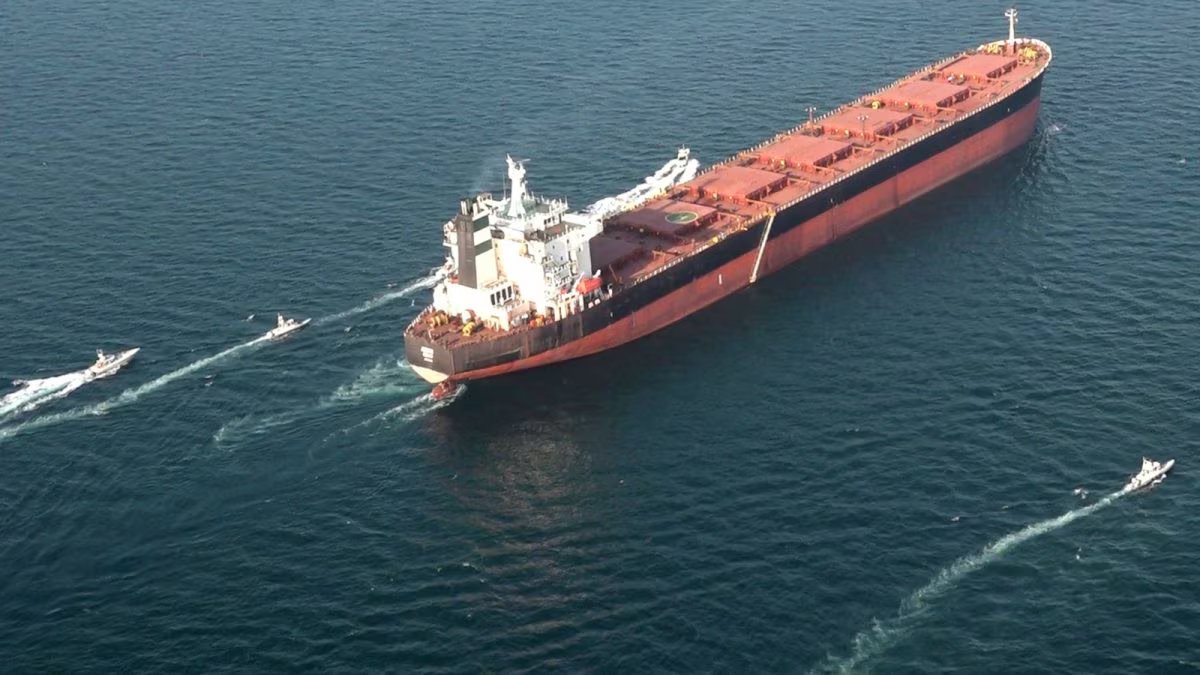
Liquefied petroleum gas (LPG) tanker Jag Vikram crossed the Strait of Hormuz between Friday night and Saturday morning, becoming the first India-flagged vessel to pass through the strategic maritime chokepoint since the announcement of a temporary two-week ceasefire between the United States and Iran, according to ship-tracking data.
The vessel is the ninth Indian-flagged ship to exit the Persian Gulf since early March.
Another 15 India-registered vessels remain in the Persian Gulf and are expected to follow its route out of the region.
As of 12 noon (India time) on Saturday, Jag Vikram was sailing in the Gulf of Oman, east of the Strait of Hormuz, moving eastwards.
Going by its capacity, Jag Vikram could be carrying up around 20,000 tonnes of LPG, according to trade sources, The Indian Express reported.
The tanker is a mid-sized gas carrier (MGC) owned by Mumbai-based Great Eastern Shipping Company, as per shipping databases. The tanker has a deadweight capacity of over 26,000 tonnes. Deadweight tonnage is the total weight a vessel can carry, including cargo, fuel, fresh water, ballast water, provisions, and crew.
According to trade sources, Jag Vikram had been awaiting clearance to cross the Strait of Hormuz for over a week. On April 3, The Indian Express had reported that LPG tankers Green Asha and Jag Vikram were expected to transit the crucial waterway within a few days. Green Asha crossed the strait on April 5.
Since the outbreak of the conflict, several vessels have remained stranded in the Persian Gulf, with only a limited number managing to safely pass through the Strait, often in coordination with Iranian authorities.
Seven of the eight other Indian LPG tankers that have crossed the Strait of Hormuz in recent weeks were very large gas carriers (VLGCs), each with more than double the LPG-carrying capacity of a medium gas carrier (MGC). Only one of them was an MGC.
Meanwhile, the remaining 15 Indian vessels still in the Persian Gulf include at least one additional LPG tanker, four crude oil tankers, one liquefied natural gas (LNG) tanker, one chemical products tanker, three container ships, and two bulk carriers, along with a few vessels currently undergoing routine maintenance.
The Strait of Hormuz is a narrow maritime passage between Iran and Oman that links the Persian Gulf with the Gulf of Oman and the Arabian Sea, making it one of the world’s most critical energy chokepoints. It handles roughly one-fifth of global oil flows, along with a significant share of liquefied natural gas shipments, underscoring its central role in international energy trade.
April 11, 2026, 14:11 IST
Read More