

Eight years after the ‘laal batti’ went out, India’s VIP culture hasn’t disappeared. It has simply learned to travel incognito.




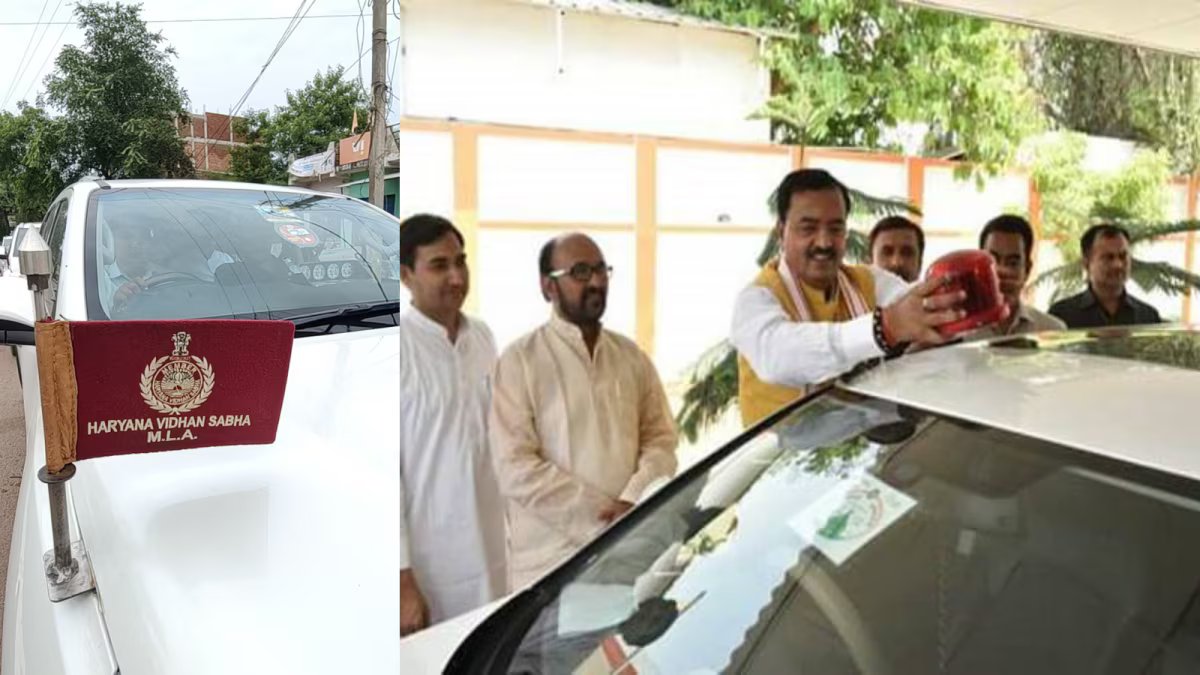
From UP’s Keshav Maurya pulling out beacons to Haryana handing 90 MLAs red flags — the optics changed, little else did. (File photos)
When Prime Minister Narendra Modi’s government scrapped beacons for VIPs in 2017, it was celebrated as the death of the ‘laal batti’ culture. Eight years on, India’s roads — especially in Uttar Pradesh — tell a very different story. The red light is gone. Everything else has stayed.
What Was The 2017 Beacon Ban?
In April 2017, the Union Cabinet declared that vehicles with beacon lights “have no place in a democratic country” and banned their use from May 1.
The Tribune Rule 108(1)(III) of the Motor Vehicles Act, which had allowed vehicles carrying high dignitaries to fix a red beacon on top, was abolished.
PM Modi marked the moment with a tweet: “Every Indian is special. Every Indian is a VIP.”
It was a landmark moment. Chief ministers across the country — including Yogi Adityanath in UP and Amarinder Singh in Punjab — made public shows of removing beacons from their cars.
UP Deputy CM Keshav Prasad Maurya even ensured photographs of him physically pulling out the red beacon from his vehicle were carried by local newspapers.
So What’s Happening Now In UP?
The theatre of removing beacons turned out to be just that — theatre. According to a Hindustan Times report, UP’s roads are now seeing a new fleet of status symbols: multicolour lights, stiff flags mounted on bonnets, embroidered insignias, and bold institutional labels plastered across vehicles.
HT report stated that some vehicles now sport embroidered titles — ‘Mukhya Sachiv’, ‘Pramukh Sachiv’, ‘Krishi Utpadan Ayukt’ — stitched alongside ‘Uttar Pradesh Sarkar’ and the state emblem.
The message being sent is the same. Only the medium has changed.
The logic is simple — if you can’t flash a red light, flash something else. Powerful individuals, their associates, and even institutions have found creative workarounds to announce authority on the road and pressure other commuters to make way.
What Do The Rules Actually Say?
After the 2017 ban, only three categories of vehicles are permitted to use coloured beacons:
• those engaged in fire control
• maintenance of law and order (police, defence, paramilitary)
• management of natural disasters.
Party flags, unauthorised insignias, and institutional stickers on private vehicles have no legal sanction either.
A widely-circulated public petition has demanded that Rule 108 of the Motor Vehicles Act be extended to ban political party flags, leader photographs, advocate symbols, press and police stickers on private and commercial vehicles — all used to evade traffic rules and intimidate law enforcement.
MV Act expert and former transport official Gangaphal was quoted by HT: “In the law, there is no provision for officials to display such flags as a status symbol on their official or private vehicles. There is flag code dealing with the national flag and its use is restricted to a handful of dignitaries.”
The report further quoted former additional commissioner of transport, Arvind Kumar Pandey, as saying that the law makes no provision for flags on vehicles.
The only exception, he noted, is likely a home department notification permitting top police officials to mount a rectangular flag on their car bonnet — and nothing beyond that.
Is UP Alone In This?
Not at all. In Haryana, shortly after the beacon ban, all 90 MLAs were given red flags bearing the logo of the Haryana Vidhan Sabha for their vehicles.
The Vidhan Sabha Speaker defended it, saying the flags were to “identify and give due recognition to MLAs when they are on the road.” Critics saw it for what it was — beacons by another name.
As recently as 2024, a trainee IAS officer in Pune was found using an unauthorised beacon on her private car — a case that underscored how the culture of entitlement persists even among those entering public service.
What Experts Say
The Supreme Court, even before the 2017 ban, had termed red beacons a “menace” and noted that their use on vehicles of public representatives and civil servants “has no parallel in world democracies.”
Analysts have long argued that banning a symbol without changing the underlying mindset achieves little. As one assessment put it, from pat-downs avoided at airport security to free passage at toll gates, the culture of entitlement is asserted in numerous ways — and banning beacons alone is not enough to dismantle it.
Eight years after the ‘laal batti’ went out, India’s VIP culture hasn’t disappeared. It has simply learned to travel incognito.
April 09, 2026, 13:56 IST
Read More